Tuesday, December 20, 2011

Thursday, December 15, 2011
Our Lady of Guadalupe
Monday, 12-12-11
It’s been a while since I’ve been to a procession. And if you’ve read my blog before you know that I love a good procession. Well, today was my day. Today we were celebrating the Feast of Our Lady of Guadalupe and there was going to be a procession after mass in her honor. In El Salvador, children and sometimes adults get dressed up on this day in indigenous dress. I wasn’t aware of this until I saw several children coming to the park dressed up. They do this because the Virgin appeared to San Juan Diego, who was an indigenous man who had converted to Catholicism.

Here is some information about Our Lady of Guadalupe:
Our Lady of Guadalupe (Nuestra Señora de Guadalupe) is a celebrated Roman Catholic icon of the Virgin Mary. Under this title, she is officially proclaimed by the Roman Catholic Church as the Patroness of Americas, Empress of Latin America, and Protectress of the Unborn Children.
According to Roman Catholic tradition, on December 9, 1531, Juan Diego, a recently converted Aztec indigenous peasant, had a vision of a young woman while he was on a hill in the Tepeyac desert, near Mexico City. The lady asked him to build a church exactly on the spot where they were standing. He told the local Bishop Juan de Zumarraga, who asked for proof in exchange.
Juan Diego went back later and saw the lady again. He told her that the bishop wanted proof, and she instructed Juan Diego to go to the mountain top, where he found Castillian roses, which were native to Bishop Juan de Zumarraga's hometown and could not possibly bloom during wintertime. Juan Diego cut the roses, placed them in his apron-like tilma and returned to the bishop; an imprint of the Blessed Virgin Mary appeared on the tilma from the residue of the soil and roses.
Today, the icon is displayed in the nearby Basilica of Guadalupe, now one of the most visited Catholic shrines in the world. The Virgin of Guadalupe is Mexico’s most popular religious and cultural image, with the titles “Queen of Mexico,” “Empress of the Americas,” and “Patroness of the Americas.” Both Miguel Hidalgo (in the Mexican War of Independence) and Emiliano Zapata (during the Mexican Revolution) carried flags bearing the image of Our Lady of Guadalupe, and Guadalupe Victoria, the first Mexican president, changed his name in honor of the icon.
Photos from the procession:






It’s been a while since I’ve been to a procession. And if you’ve read my blog before you know that I love a good procession. Well, today was my day. Today we were celebrating the Feast of Our Lady of Guadalupe and there was going to be a procession after mass in her honor. In El Salvador, children and sometimes adults get dressed up on this day in indigenous dress. I wasn’t aware of this until I saw several children coming to the park dressed up. They do this because the Virgin appeared to San Juan Diego, who was an indigenous man who had converted to Catholicism.
Our Lady of Guadalupe
Our Lady of Guadalupe (Nuestra Señora de Guadalupe) is a celebrated Roman Catholic icon of the Virgin Mary. Under this title, she is officially proclaimed by the Roman Catholic Church as the Patroness of Americas, Empress of Latin America, and Protectress of the Unborn Children.
According to Roman Catholic tradition, on December 9, 1531, Juan Diego, a recently converted Aztec indigenous peasant, had a vision of a young woman while he was on a hill in the Tepeyac desert, near Mexico City. The lady asked him to build a church exactly on the spot where they were standing. He told the local Bishop Juan de Zumarraga, who asked for proof in exchange.
Juan Diego went back later and saw the lady again. He told her that the bishop wanted proof, and she instructed Juan Diego to go to the mountain top, where he found Castillian roses, which were native to Bishop Juan de Zumarraga's hometown and could not possibly bloom during wintertime. Juan Diego cut the roses, placed them in his apron-like tilma and returned to the bishop; an imprint of the Blessed Virgin Mary appeared on the tilma from the residue of the soil and roses.
Today, the icon is displayed in the nearby Basilica of Guadalupe, now one of the most visited Catholic shrines in the world. The Virgin of Guadalupe is Mexico’s most popular religious and cultural image, with the titles “Queen of Mexico,” “Empress of the Americas,” and “Patroness of the Americas.” Both Miguel Hidalgo (in the Mexican War of Independence) and Emiliano Zapata (during the Mexican Revolution) carried flags bearing the image of Our Lady of Guadalupe, and Guadalupe Victoria, the first Mexican president, changed his name in honor of the icon.
Photos from the procession:

Before the procession

The church in Berlin

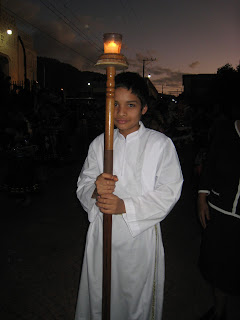
Very handsome

These are my little friends from the park

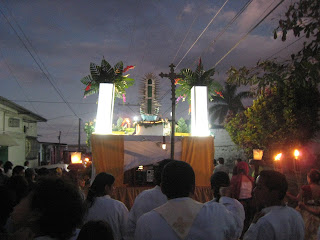
The Virgin of Guadalupe

A crowd begins to gather

Lots of people

Beautiful dresses

This little girl looks like a doll

Amazing eyes

Too cute

The flowers complete the outfits

Aminta's grandson

Leaving the church

We're ready

Heading to the where the procession will begin

Here comes Father Jacobo

This little guy walked with us

Dresses with the Virgin on them

Getting in place

One of my students

There's the float!

Leaving the church

From the back

The Virgin

These guys stood the whole way

The procession was more than an hour

Walking along

Carrying torches at the front of the procession

People followed behind the float

It was a beautiful night

Take our picture, please!
Saturday, December 10, 2011
Walk to the cross
I had a chance not too long ago to walk to the cross. The cross is a big, white cross that stands at the top of a huge hill. I say hill, but it’s more like a mountain. I’m not sure how the cross got there, but I know it’s been there for a while, and everyone in Berlín knows “la cruz” (the cross).
I had wanted to get to the cross in September when Sue and Nancy were here, but after I started the walk I had to turn back because I’d become incredibly sick. So I’m really glad I got the opportunity to go. Walking to the cross was one thing on my to-do list. I’d only been up once before and that was last year.
I walked up with the gym teacher from my school, another teacher from the school and her granddaughter, a student from my school, and several people from the US and other parts of El Salvador. The people from the US and other Salvadorans are related to the secretary at my school. I was excited to meet everyone.
We met in front of the school around 7:30am. It takes about an hour to walk up to the cross and the walk is strenuous. We wanted to get an early start to avoid the heat of the sun. After meeting and making introductions we started the trek up. While some parts of the trail aren’t too bad other parts are very steep for a long period of time. Along the way we passed lots of flowers of all sorts of colors. I saw some flowers that were very blue and some orange ones that are called flor de muerte (death flower).




I had wanted to get to the cross in September when Sue and Nancy were here, but after I started the walk I had to turn back because I’d become incredibly sick. So I’m really glad I got the opportunity to go. Walking to the cross was one thing on my to-do list. I’d only been up once before and that was last year.
I walked up with the gym teacher from my school, another teacher from the school and her granddaughter, a student from my school, and several people from the US and other parts of El Salvador. The people from the US and other Salvadorans are related to the secretary at my school. I was excited to meet everyone.
We met in front of the school around 7:30am. It takes about an hour to walk up to the cross and the walk is strenuous. We wanted to get an early start to avoid the heat of the sun. After meeting and making introductions we started the trek up. While some parts of the trail aren’t too bad other parts are very steep for a long period of time. Along the way we passed lots of flowers of all sorts of colors. I saw some flowers that were very blue and some orange ones that are called flor de muerte (death flower).

Starting the trek

Up and up we go

A look down at Berlin

Keep going

I can see my house!
(Not really)

San Vicente

A race to the top

Flowers growing out of the wall

Are we there yet?
We also saw a lot of coffee. This time of the year the coffee is starting to ripen. The coffee cherries start out green, then turn yellow, and finally red. Several people were out in the coffee field (finca) picking coffee. Close to the top we passed by a coffee processing place. Lots of coffee was sitting outside to dry. I could also see the machines they use to take the skin off the coffee before it’s laid out to dry.
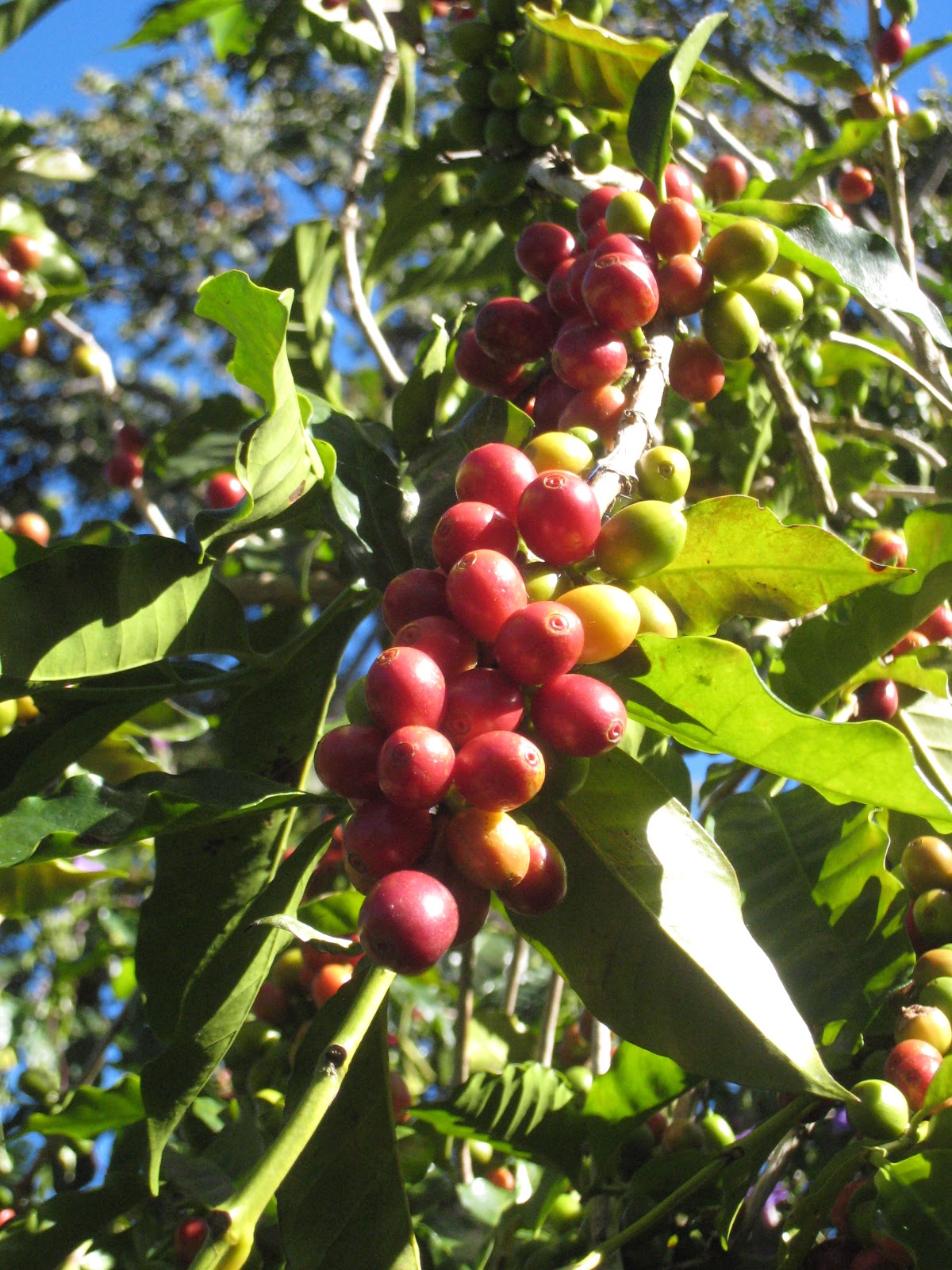
Coffee cherries

Picking coffee

Hard work

Posing for the camera

Private property - the coffee place

The processing area

To the right is coffee laying out to dry
Finally we made it to the cross. The air was cool and I almost felt chilly. We all found a seat underneath it and took in the view. You could see the entire town of Berlín and some of the cantons. I was able to see the pine trees that stand in the park and the church next to them. One of the teachers had brought binoculars that we passed around. Someone else had brought snacks that we enjoyed while we sat

Beautiful flowers

We made it!

You can see the whole town

A closer look

In front of the cross

There we are

Looking up

Breathtaking
After a while we started walking again. I wasn’t sure where we were going but I was excited to find out. Soon we came upon a field full of lush grass. Parts of the grass looked almost purple. We saw a small pond nearby and I told the kids that they should go for a swim. One of them actually did! Then we walked back to the meadow. I sat down and marveled at my surroundings. The air was sweet and the sky was so blue. It made me feel good to be alive.

Continuing on

A machete

Corn fields

Running across the meadow

Lush grasses

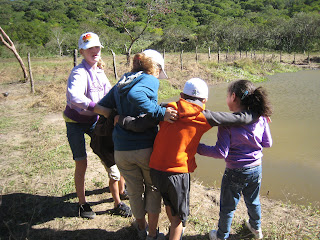
Standing by the small pond

Look!

Don't push me in!

Hundreds of flowers

Open and free

I love these flowers

Taking a rest

Blue skies smiling at me

Vibrant colors
About 30 minutes later we began our walk back to the cross. From there we headed back down the mountain to Berlín. It had been a wonderful adventure.

Heading back

Saying goodbye to the cross

A glimpse of San Vicente

A field of flowers

On our way down

Here we are!

Underneath the black diamond are the
pine trees in the park in Berlin close to
the Pastoral House
Subscribe to:
Posts (Atom)