We had the opportunity to visit the community of Río de los Bueyes with the delegation. We were going to hear the testimonies of the people in the community who lived during the Civil War. If you have ever read “The Massacre at El Mozote” or any other books about the Civil War in El Salvador you know how brutal the war was. The testimonies we heard contained extreme violence and tragedy. With that said, please know that the testimonies that follow are graphic and disturbing.
Civil War
Here is a brief summary of the Civil War in El Salvador. The Salvadoran Civil War (1980–1992) was a conflict in El Salvador between the military-led government of El Salvador and the Farabundo Martí National Liberation Front (FMLN), a coalition of five left-wing militias. Significant tensions and violence had already existed, before the civil war’s full outbreak, over the course of the 1970s. During the course of the 12-year war an estimated 75,000 people or more were killed (probably more), 7000 people went missing, and the US government gave a staggering $6 billion to the Salvadoran government’s war effort.
Part of the Salvadoran army during the war included 5 special battalions trained in the US at the School of the Americas. The Salvadoran soldiers weren’t well-trained and were more disorganized before they attended training in the US. The most famous of those battalions trained by the US was the Atlacatl Battalion who committed some of the worst atrocities during the war including the massacre at El Mozote and the murder of the 6 Jesuit priests, their housekeep, and her daughter.
The UN Peace Commission that investigated allegations of human rights abuses after the war found that most of the atrocities (disappearances, murder, rape, torture, etc.) committed during the war were carried out by government. “Based on collected testimony the commission attributed 85% of the acts of violence to State agents (the government), which took place predominantly in rural areas. Approximately 5% of the acts of violence were attributed to the FMLN.” http://www.usip.org/publications/truth-commission-el-salvador
In accordance with the Peace Commission, the government agreed to various reforms, including dismantling paramilitary groups and death squads and replacing them with a national civil police force. Furthermore, land was to be distributed to citizens. In return, the government granted amnesty to those responsible for human-rights abuses (i.e. the government and military).
Testimony from the community
Manual, the vice-president of the Directiva, explained to us that where we were: Río de los Bueyes was an FMLN controlled area during the war and was considered a war zone. He explained that the memorial celebration held every April 30th and May 1st (which I attended) is in memory of those who were killed from their area during the war. Everyone from the community lost someone during the war. Right now the community is constructing a memorial wall in memory of those who were killed.
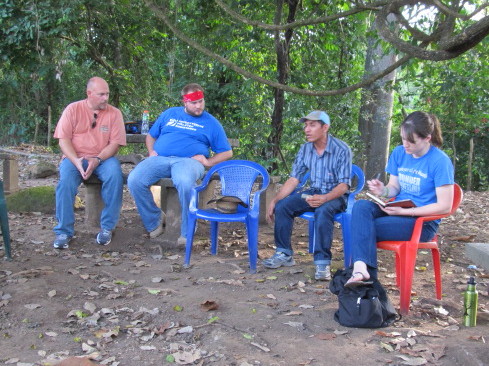
Listening to testimony

Hearing their stories
The first thing he did was show us a photo of himself during the war. The photo is of him and another young man both holding M-16 assault rifles. He is 15 years old in the picture but he was 12 years old the first time he picked up a gun. He told us that if the army found you, you’d be killed. So Juan was on the run during the war with his parents and brothers and sisters. Life during the war was life on the run.
In 1985, in the area where he was, the FMLN started taking older people, women, and children out of the area and moved them to Santa Cruz to keep them safe. They constructed champas (little houses) for them. But the women in the champas often had to leave their sons behind to fight. If they were old enough to carry a gun then they were old enough to fight. Since Juan spent his life on the run and fighting he never had time for school so he never learned to read or write. This is the same case for many people. But they didn’t take up arms because they wanted to kill people. They did it because they wanted to protect themselves.
Juan finished his testimony by telling us that the people in the community tell the stories about the war to their children. They do this because they want their children to know what happened. They don’t want what happened to them to happen to their children.

Taking up arms
Blanca was 18 years old when the war started in 1980. Everyone was poor at the beginning of the war and things were too expensive. The armed forces went house to house to recruit people for the war. Blanca decided to join the guerillas because she was poor and had nowhere to work. Some women who joined the guerillas carried guns and fought while others cooked. She worked as a cook for the guerillas. On March 12 of that year the army killed her grandmother and her two sisters. Having family members killed was one reason people joined. Many youth joined the guerillas and went to live up in the mountains. They often survived on 1 tortilla a day and maybe some roots.
In 1982 her mother and two other sisters disappeared from their home. Blanca searched for them but never found them. [Side note- Thousands people disappeared during the war. When this happened it usually meant that they had been killed and their bodies not found]. Blanca said that the army killed thousands of innocent children and older people during the war. She says the Salvadoran people need to remember those that gave their life and who struggled to help them have a better life.
In 1983 a bomb landed near to where she was staying. Some shrapnel from the bomb flew into her leg. When she recovered a little she was able to start cooking again. But to this day she still had a limp. Blanca told us that what was in the newspapers and on the radio during the war wasn’t true; it wasn’t their story. That’s another reason why it is so important to keep telling the story.
José Ramon
José began by telling us that everyone had a different experience during the war. It was the social injustice that started the war. People wanted justice. But if someone mentioned the words the government or military considered it a crime. This was why Romero was killed; he spoke out against injustice. This made people angry, and the guerillas began fighting because they wanted justice.
The zone he was in was labeled as a guerilla area. It was a dangerous area, especially in the cantons of Talpetates and Corozal (Rio de los Bueyes is a part of Corozal). If the military found them there they’d be killed. They would often ask people for their documentation. If people weren’t carrying their identification information with them they’d be killed.
The military was trained to kill and massacre people. José saw several massacres and killings committed by the army. He spoke of Major Roberto D’ Aubuisson, the founder of the right wing ARENA party, who created the death squads. These squads were responsible for the disappearances and murders of thousands of people. They especially targeted people who proclaimed social justice.
José joined the war in 1986. He met Juan José (who also spoke today) when he was 11 or 12 years old. They were in the same area but in different combat units.
Paula
Paula joined the war in 1980 when she was 6 years old. At that time she and her family went to live in the canton of Santa Cruz which is also in the municipality of Berlín. She herself first picked up a gun to fight when she was 14 years old. She said that the life they lived when they were children was very sad. They spent a lot of time hungry, tired, and cold because they lived life on the run.
Paula spent a lot of time talking about what the guerillas would eat to survive. At one point they had to stay hidden in a ravine and couldn’t leave. They were there for 24 days. They cut away the bark from the tree and ate the inside parts. They also ate mangoes they found on the ground. During this time she gave birth to one of her children. The baby had breast milk and also little bits of mango. She fed her other children hard tortillas so they wouldn’t cry. If they cried then the army would find them. At other times during the war they would eat the roots of plants to stay alive. There was also a specific kind of flower that they would eat.
Paula lost family during the war. Two of her nephews died in combat in 1988. She also mentioned that people she knew were burned to death in 1980. That was all she wanted to say.

Members of the community that talked

Brave people
Manuel Chaves
Manuel is the vice-president of the Directiva. He was 6 years old when the war started in 1980. He wanted to continue school but wasn’t able to because of the war. When the war started the army would go house to house killing people. They’d burn clothes, houses, food, animals, and anything else they could find. They’d kill pregnant women, kids, old people, anyone. He and his family joined the guerillas for protection. One day his family knew the army was coming so they left. When they went back to their house to see if anything was left all they found was a hole in the ground; the army had dropped a bomb on their home. Shortly after that they all ran away for good.
Manuel said that he and his siblings were just little kids and didn’t fully understand what was going on. When they were hiding they didn’t have any food so their mom would give them harina (corn flour) mixed together with water so they wouldn’t cry. She’d also look for conacaste seeds to boil and eat. They’d cut out the “heart” of the banana tree to suck the liquid out of it. His mother had four children who she carried with her during the war.
In 1981 during the nearby La Quesera massacre his mother gave birth. He remembered that it was raining a lot and as soon as the baby had come out they had to start running again. They would see dead people along the way that had died from lack of food and water. There were people who’d been killed by soldiers too. They also saw dying people but couldn’t stop to help or they would be dead too. But it wasn’t just the guerillas that were killed. It was everyone. The army would drop bombs on communities. People would dig holes so they could hide inside when the planes flew overhead. These holes were called “tatus.”
Manuel said that they killed to defend themselves. To defend their mothers and children that were dying. For example, his mother is sick from nerves (probably Post Traumatic Stress Disorder) because she saw her son tortured and killed in front of her own eyes. But Manual said peoples’ deaths were not in vain. They are remembered. It is important for their community to have the remembrance celebration on April 30th and May 1st because many people died during the war. He said that people in the community have many stories to tell and the stories need to be told so they aren’t lost. People need to remember these stories.

Manuel telling his story
After being asked about what happened to his right arm José then told us about the loss of his arm. He said that he was with his unit getting ready to fight the army. What they did not know was that another guerilla unit was also in the area and had already fought that same particular army group. They didn’t know because there wasn’t good communication and there was a lot of disorganization.
So he and another guy went to the same place. Unfortunately, since the army had been fighting the other unit they were on alert and figured out another unit was coming. José was behind the other person he was with. He said that when they were fired at he went to shoot his gun but his right arm was gone. He looked down and saw it hanging, attached by two small pieces of skin. His gun had been broken from another bullet and he’d also been shot just under his armpit. His friend in front of him had died.
At that point he hid and then went to go back to the base area. When he returned without his friend his commander asked what had happened to the other man. When José told him that he’d been killed his commander didn’t believe him. He said the other man was too smart and too quick to be killed.
Later, his commander and some doctors got a metal plate to put in his arm to keep it attached. He said that it helped a little but he wasn’t able to use his fingers. He asked if he’d be able to fight again and they told him no. He told them that he started, so he would finish. Later he told them that they could take the dead part of his arm off. After it was removed he took a test to see if he could fight and he did very well. So he was able to fight again. Eventually he took over the unit.
He finished his story by telling us that he had an obligation to survive. Once the war was over he wanted to do something in agriculture. And now he’s a farmer.

Jose explaining the loss of his arm
After the testimonies we went to go see the area where the waters reached the community. It was only a short walk. They took us down a path and pointed out the place where the water had finally stopped after the Lempa River flooded. Several of the homes in the area were filled with flood water back in October during the storms. A priest from another community, a Baptist church in the US, and the Pastoral Team were the only ones who helped the community during the October floods.
Memorial Wall
Then we went to go see the place where the memorial wall is being built. The wall will have the names of everyone who died in their community during the war. The community has received donations from the two delegations that have gone to visit them and listen to their testimony. The wall is very valuable to them. The group said that papers with people’s names can be destroyed, but the memorial wall will last.

Talking to Jose's daughter

The wall

A water faucet in the community

A washing station in the now dry creek
We returned to the truck after viewing the area where the water had risen and seen the wall being constructed. There we talked to someone who told us a story of one of the women who’d come to tell her testimony but wasn’t emotionally able to talk to us. Before she even told us her name she had broken down into tears.
Something very ugly happened to her family during the war. Her pregnant daughter was taken by the Salvadoran army, raped, and killed. Her baby was then cut out of her stomach and placed on her naked body to look like it was breastfeeding. Tragically, this was not an uncommon event during the war. Women who were caught or taken were often brutally violated by Salvadoran army. The soldiers targeted the unborn children of pregnant women when committing these atrocities.
It was an awful story to hear and a very unsettling way to end our time in the community. For me, it’s unfathomable and terrifying to think about what human beings do to each other.

The road to the community

Late in the evening

Sugarcane flowers


