Tuesday, 5-17-11
The Pastoral Team got a phone call yesterday that a young man named Josué from the canton of Santa Cruz had been killed in a car accident in San Salvador. He left behind his young wife, mother, and brother. Everyone who lives in the cantons here is poor, but Santa Cruz is especially poor and lacks resources available to other cantons. His family is worse off than others in the canton. His brother’s young children are very sick and aren’t able to afford money for the medication they need.
The funeral was to be Tuesday sometime but we didn’t know when. Josué’s body still needed to be brought back from San Salvador. Cecilia, Kathy, and I went out to buy pan dulce, plates, and cups for the family. The family was going to be returning from San Salvador with Josué and then going to their home in Santa Cruz. As with most deaths here, the deceased stays at the house during the night. There the deceased is cleaned and dressed. The family stays with them throughout the night to mourn the loss. We bought the pan dulce for the vigil they would be having.
After we picked up the bread Cecilia called to see when people would be stopping by to pick up the bread. They were still in San Salvador and wouldn’t be arriving until around 1am. So Cecilia went to bed early so she could get up when they came to the door. This is common here. If someone won’t be arriving until late at night or in the wee hours in the morning the ladies will go to sleep and the person will call when they get to the house. We weren’t sure when or where the funeral was going to be held but Cecilia said she would find out when they stopped by that night.
This morning Cecilia told us they’d stopped by around 1am but still weren’t sure about the funeral plans. So I went to school and Kathy said she’d call when they heard something. She called around 9am saying the funeral was going to be in Berlín at 10am. I left school around 9:30am and walked home. As soon as I got home Cecilia, Kathy, and I began walking to the cemetery.
A somber feeling passed over me as soon as we arrived. When we walked through the gates I heard women singing. The casket was in the middle of the entrance and a couple women were off to the side weeping uncontrollably on the ground. It was his young wife and other family members. I felt my face get red and my eyes filled up with tears. Seeing his family in so much pain was overwhelming. I wanted so much for this event never to have happened. I wanted everything to be the way it was a week ago. I just stood there in silence trying to make sense of it all.
Several people I knew from the cantons had come to show their support and pay their respects. Many had brought flowers to place on the casket and grave. One couple walked up to the casket and laid white roses on it. The rest stood nearby holding an assortment of flowers. Most of the flowers were the kind you’d find at people’s houses. Here, people don’t necessarily go to the store to buy flower arrangements for funeral or order them over the internet. They use the natural beauty they find around them.
Daniel from San Francisco was there to lead everyone in a short service at the cemetery. For a while my mind drifted as he spoke. Then I heard him talking about a grain of wheat that falls to the ground and I was brought back to the present. I remembered hearing similar words a few weeks ago but couldn’t figure out when. It was a Bible verse from John: “I tell you the truth, unless a kernel of wheat falls to the ground and dies, it remains only a single seed. But if it dies, it produces many seeds.” –John 12:24
Also, the theme of fallen grains of wheat is present in a beautiful song called “Entre tus Manos” (In your Hands), which I heard people singing today:
Entre tus manos está mi vida Señor,
Entre tus manos pongo mi existir,
Hay que morir para vivir.
Entre tus manos pongo yo mi ser.
Si el grano de trigo no muere,
si no muere, solo quedará,
pero si muere en abundancia dará
un fruto eterno que no morirá.
__
In your hands is my life Lord,
In your hands I put my existence,
We must die to live.
In your hands I put my being.
If the grain of wheat does not die,
if it does not die, it remains,
But if it does die, in abundance it will give
an eternal fruit that will not die
As I stood listening to Daniel talk and people crying at the same time a couple contrasts stood out that differentiate funerals in the US from funerals in El Salvador; more specifically, the cantons of El Salvador. Clothing was one of those contrasts. In the US people get dressed up for funerals. They may wear darker colors or something conservative. At today’s funeral no one was really dressed up, including the family. People wore their regular clothes. A couple of the women still had their aprons on. The funeral I went to on Saturday was similar.
Music is also different than many American funerals. Many times it’s recorded music. If not recorded then someone playing the organ or piano. Maybe a choir singing. Today at the cemetery a group of women were singing It wasn’t anything formal. They may or may not have planned ahead what they would sing, and anyone was welcome to join in at any time. No one had any music. All the songs that are sung are ones people recognize because they’re the songs people have been singing their whole life. I recognized a couple because we’ve sang them at church before.
Most of the caskets for sale here in El Salvador have little windows with a door in front of them that can be opened and shut. The window is small and positioned so that people can see the face of the deceased. Sometimes it’s opened so people can walk up and look into the casket. Other times it’s closed, but anyone is free to go up to the casket and open the window. It’s not considered inappropriate to open the window yourself even if you didn’t know the deceased very well. I chose not to look. Even though it’s perfectly acceptable I still felt like it would be invading their privacy. I feel my looking would have been done out of morbid curiosity instead of more pure motives.
As Daniel was finishing what up he was saying another group of people arrived at the cemetery with a casket in their pickup. There were three internments today at the cemetery and it was time for us to continue on. Several men hoisted the box onto their shoulders and we began the walk to the gravesite. It was quite a trek. Unlike cemeteries in the US, here you have to navigate through weeds, over branches and other debris, and around fallen headstones. It’s not the simple walk to the grave that I normally associate with burials.
When we arrived at the gravesite the young widow stayed back a little ways from the grave. She was in so much pain. The other family members stayed with her. It was there I learned that Josué’s mother had not come to the cemetery. She was sick with grief, her loss too much to bear. The hole had been dug ahead of time, and Daniel said a few more words before the casket was lowered into the ground with ropes. Then several men took their shovels and started filling the grave. At that point I could hear the widow sobbing again, and Josué’s brother became weak at the knees. Several of his friends had to help him walk away to get some air.
There were lots of sounds around us while the grave was being filled. Some I associated with funerals and burials such as songs and weeping. Other sounds, such as dogs and turkeys, seemed out of place. I could hear the dirt hitting the casket and the family crying. Someone was cutting down weeds nearby with a machete. A man came around trying to sell ice cream, ringing a bell to announce his presence. As with the funeral on Saturday, I felt annoyed at the person ringing the bell and thought it incredibly rude.
Soon after this we began walking back to the house. We’d spent most of the time at the cemetery in silence. I wasn’t sure what to say. I was still processing everything that had happened. It was a sad morning.
Later in the day I was listening to some songs performed by Susan Boyle. As I was listening to the song “Make Me a Channel of Your Peace” I began to think about the funeral today and I started to cry. The sadness of it all rushed back to me. It’s a beautiful song, and similar to the Bible verse in John it talks about dying to bring about eternal life. Below are the lyrics to the song:
Make me a channel of your peace.
Where there is hatred let me bring your love.
Where there is injury, your pardon, Lord
And where there's doubt, true faith in you.
Make me a channel of your peace
Where there's despair in life, let me bring hope
Where there is darkness, only light
And where there's sadness, ever joy.
Oh, Master grant that I may never seek
So much to be consoled as to console
To be understood as to understand
To be loved as to love with all my soul.
Make me a channel of your peace
It is in pardoning that we are pardoned
In giving to all men that we receive
And in dying that we're born to eternal life.
Showing posts with label Tough stuff. Show all posts
Showing posts with label Tough stuff. Show all posts
Wednesday, May 18, 2011

Sunday, May 15, 2011
Death in the cantons
Saturday, 5-14-11
Sickness & Death
Two weeks ago I went to the community of Río de los Bueyes for their annual Celebration of the Martyrs where Balmore was going to do a Celebration of the Word. Before the celebration started we went to see an older woman, named Jesús, and her family that live not far from where the celebration was being held. I’d never met her before but the Pastoral Team and Kathy know her well.
She was very sick when we went to see her; almost all skin and bones. Since she wasn’t eating much she had a nutrient supplement hanging up in what appeared to be an IV bag. It was a strange sight for the cantons. I asked Kathy about it and she said that a health promoter might be the one who helps out and administers the IV. We stayed a short while talking to her family. Jesús only stayed to talk for 20 minutes before she tired and went to her room to lay down.
Yesterday the Pastoral House got a call that Jesús was asking for the Pastoral Team. So Blanca, Cecilia, and Kathy drove to Río de los Bueyes to see her. They only stayed 30 minutes because Jesús was weary and very sick. Kathy said she wasn’t eating or drinking and she was coughing up blood. Her stomach was bloated. We all knew she was close to death.
Last night they got a call that Jesús had died. The burial was to be tomorrow. Normally the Pastoral Team goes to someone’s house right after there has been a death to provide moral support, but because it was late and a storm was coming they decided to wait until tomorrow. Sometime around 11:00pm the family stopped by to pick up some money from the Pastoral House. The Pastoral Team often helps families with funeral expenses.
At this point let me explain a little bit about what happens to a body after death here in El Salvador. When someone dies here in the cantons the body usually remains at the house. They are not taken to the morgue or a funeral home. There isn’t embalming done the way it’s done in the US. In the US you usually have embalming chemicals for the blood vessels and the body cavity itself. Hypodermic and surface embalming can be done if needed. The ideas behind embalming in the US are sanitation, presentation, and preservation.
Here in El Salvador in the cantons if the family has enough money they can pay a health promoter or someone else to come and give an injection of formaldehyde into the body in order to preserve the body. The chemicals for an injection can be bought at a pharmacy. This is done usually for preservation of the body. Even though people here are typically buried soon after death it is a hot country and the body is normally kept in the home until burial. However, many people in the cantons cannot afford this injection so there is no preservation done.
Someone from the family goes to purchase the casket for their loved one. Like in the US, there are special stores, called funererias, where you can purchase caskets. The casket can be delivered to the home or the family can take it there themselves. These places serve people at all hours. I asked Cecilia about it and she told me that if it’s the middle of the night (like with Jesús) you basically knock on the door and then go in to purchase the casket.
Unlike in the US, the families in the cantons are the ones that typically prepare the body for burial. Some families have more resources than others but most of the time not much is done to the body. The family will dress the person and sometimes wash the body beforehand. A towel may be tied around the face to help keep the mouth closed. Other than that not much else is done to the body, especially if the family is from the cantons and doesn’t have a lot of money.
One thing is for sure: the body isn’t as “pretty” after death as it is in the US. In the US, several different things are often done to the body. Moisturizing cream can be added to the skin and lips so they don’t dry out. Makeup is often added to the person. A heavy makeup is used to cover bruises, cuts, or other things. Makeup is also used to make the person still look as if blood is flowing through their veins. A person’s hair may be styled, fingernails painted, or their face shaved. They are usually dressed in business attire such as a coat and tie or suit for men and a dress or pantsuit for women.
Procession
Today was to be the burial (entierro) of Jesús. We piled into the pickup and headed down to Río de los Bueyes. It’s about a 55 minute drive there and you can feel it getting hotter as you drive down the mountain. We were a little late but no one had left the house yet because they were all waiting for a big truck to carry people to the cemetery. We stood around for a while at the house and talked to a few people. When the truck to haul the people still had not arrived 15 minutes later they decided to start the procession.
Family members helped lift the casket into the back of a pickup truck. Five people got into the back with the casket while Jesús’ daughter and a grandchild got into the cab. There was no tailgate so a rope was tied in its place to prevent the casket from sliding out during the drive. A piece of cardboard was stuck between the casket and the rope to ensure the casket wouldn’t be scratched. Then the truck started driving away at a slow pace.
I was in the back of the Pastoral Team’s truck along with 21 other people. I didn’t know we could fit that many people in the back of the truck. There were also 4 people in the cab of the truck for a total of 26 people. As we slowly drove to the cemetery more people joined the procession. There were at least 4 more pickup trucks carrying people as well as 2 giant trucks full of people. As we drove along more people were waiting by the side of the road to be picked up to go to the cemetery.
It was a long procession that lasted over an hour, and it was a very hot, dusty ride. Not a long distance, but we moved slowly. It must have been in the mid-90s down in the valley and that coupled with 21 other people in the hot sun makes for a long ride. I was drenched in sweat and not terribly comfortable. I had no idea where the cemetery was or how far away it was but I didn’t want to ask for fear of sounding rude and impatient. I later learned that Kathy was very tired and was trying not to nod off at the wheel. It’s not exactly cool inside the truck either.
This is how people get to the cemetery in El Salvador, even when the person has money. There’s either a long procession by car with some people crowded into a pickup truck or other large truck or the casket is carried in a pickup while people walk behind it to the cemetery. Many times the people who are walking behind the truck with the casket sing songs along the way. I’ve seen many processions but had never been a part of one.


Remembering the Deceased
Sickness & Death
Two weeks ago I went to the community of Río de los Bueyes for their annual Celebration of the Martyrs where Balmore was going to do a Celebration of the Word. Before the celebration started we went to see an older woman, named Jesús, and her family that live not far from where the celebration was being held. I’d never met her before but the Pastoral Team and Kathy know her well.
She was very sick when we went to see her; almost all skin and bones. Since she wasn’t eating much she had a nutrient supplement hanging up in what appeared to be an IV bag. It was a strange sight for the cantons. I asked Kathy about it and she said that a health promoter might be the one who helps out and administers the IV. We stayed a short while talking to her family. Jesús only stayed to talk for 20 minutes before she tired and went to her room to lay down.
Yesterday the Pastoral House got a call that Jesús was asking for the Pastoral Team. So Blanca, Cecilia, and Kathy drove to Río de los Bueyes to see her. They only stayed 30 minutes because Jesús was weary and very sick. Kathy said she wasn’t eating or drinking and she was coughing up blood. Her stomach was bloated. We all knew she was close to death.
Last night they got a call that Jesús had died. The burial was to be tomorrow. Normally the Pastoral Team goes to someone’s house right after there has been a death to provide moral support, but because it was late and a storm was coming they decided to wait until tomorrow. Sometime around 11:00pm the family stopped by to pick up some money from the Pastoral House. The Pastoral Team often helps families with funeral expenses.
At this point let me explain a little bit about what happens to a body after death here in El Salvador. When someone dies here in the cantons the body usually remains at the house. They are not taken to the morgue or a funeral home. There isn’t embalming done the way it’s done in the US. In the US you usually have embalming chemicals for the blood vessels and the body cavity itself. Hypodermic and surface embalming can be done if needed. The ideas behind embalming in the US are sanitation, presentation, and preservation.
Here in El Salvador in the cantons if the family has enough money they can pay a health promoter or someone else to come and give an injection of formaldehyde into the body in order to preserve the body. The chemicals for an injection can be bought at a pharmacy. This is done usually for preservation of the body. Even though people here are typically buried soon after death it is a hot country and the body is normally kept in the home until burial. However, many people in the cantons cannot afford this injection so there is no preservation done.
Someone from the family goes to purchase the casket for their loved one. Like in the US, there are special stores, called funererias, where you can purchase caskets. The casket can be delivered to the home or the family can take it there themselves. These places serve people at all hours. I asked Cecilia about it and she told me that if it’s the middle of the night (like with Jesús) you basically knock on the door and then go in to purchase the casket.
Unlike in the US, the families in the cantons are the ones that typically prepare the body for burial. Some families have more resources than others but most of the time not much is done to the body. The family will dress the person and sometimes wash the body beforehand. A towel may be tied around the face to help keep the mouth closed. Other than that not much else is done to the body, especially if the family is from the cantons and doesn’t have a lot of money.
One thing is for sure: the body isn’t as “pretty” after death as it is in the US. In the US, several different things are often done to the body. Moisturizing cream can be added to the skin and lips so they don’t dry out. Makeup is often added to the person. A heavy makeup is used to cover bruises, cuts, or other things. Makeup is also used to make the person still look as if blood is flowing through their veins. A person’s hair may be styled, fingernails painted, or their face shaved. They are usually dressed in business attire such as a coat and tie or suit for men and a dress or pantsuit for women.
Procession
Today was to be the burial (entierro) of Jesús. We piled into the pickup and headed down to Río de los Bueyes. It’s about a 55 minute drive there and you can feel it getting hotter as you drive down the mountain. We were a little late but no one had left the house yet because they were all waiting for a big truck to carry people to the cemetery. We stood around for a while at the house and talked to a few people. When the truck to haul the people still had not arrived 15 minutes later they decided to start the procession.
Family members helped lift the casket into the back of a pickup truck. Five people got into the back with the casket while Jesús’ daughter and a grandchild got into the cab. There was no tailgate so a rope was tied in its place to prevent the casket from sliding out during the drive. A piece of cardboard was stuck between the casket and the rope to ensure the casket wouldn’t be scratched. Then the truck started driving away at a slow pace.
I was in the back of the Pastoral Team’s truck along with 21 other people. I didn’t know we could fit that many people in the back of the truck. There were also 4 people in the cab of the truck for a total of 26 people. As we slowly drove to the cemetery more people joined the procession. There were at least 4 more pickup trucks carrying people as well as 2 giant trucks full of people. As we drove along more people were waiting by the side of the road to be picked up to go to the cemetery.
It was a long procession that lasted over an hour, and it was a very hot, dusty ride. Not a long distance, but we moved slowly. It must have been in the mid-90s down in the valley and that coupled with 21 other people in the hot sun makes for a long ride. I was drenched in sweat and not terribly comfortable. I had no idea where the cemetery was or how far away it was but I didn’t want to ask for fear of sounding rude and impatient. I later learned that Kathy was very tired and was trying not to nod off at the wheel. It’s not exactly cool inside the truck either.
This is how people get to the cemetery in El Salvador, even when the person has money. There’s either a long procession by car with some people crowded into a pickup truck or other large truck or the casket is carried in a pickup while people walk behind it to the cemetery. Many times the people who are walking behind the truck with the casket sing songs along the way. I’ve seen many processions but had never been a part of one.

Driving through Casa de Zinc
en route to Rio de los Bueyes

Looking back at the mountains
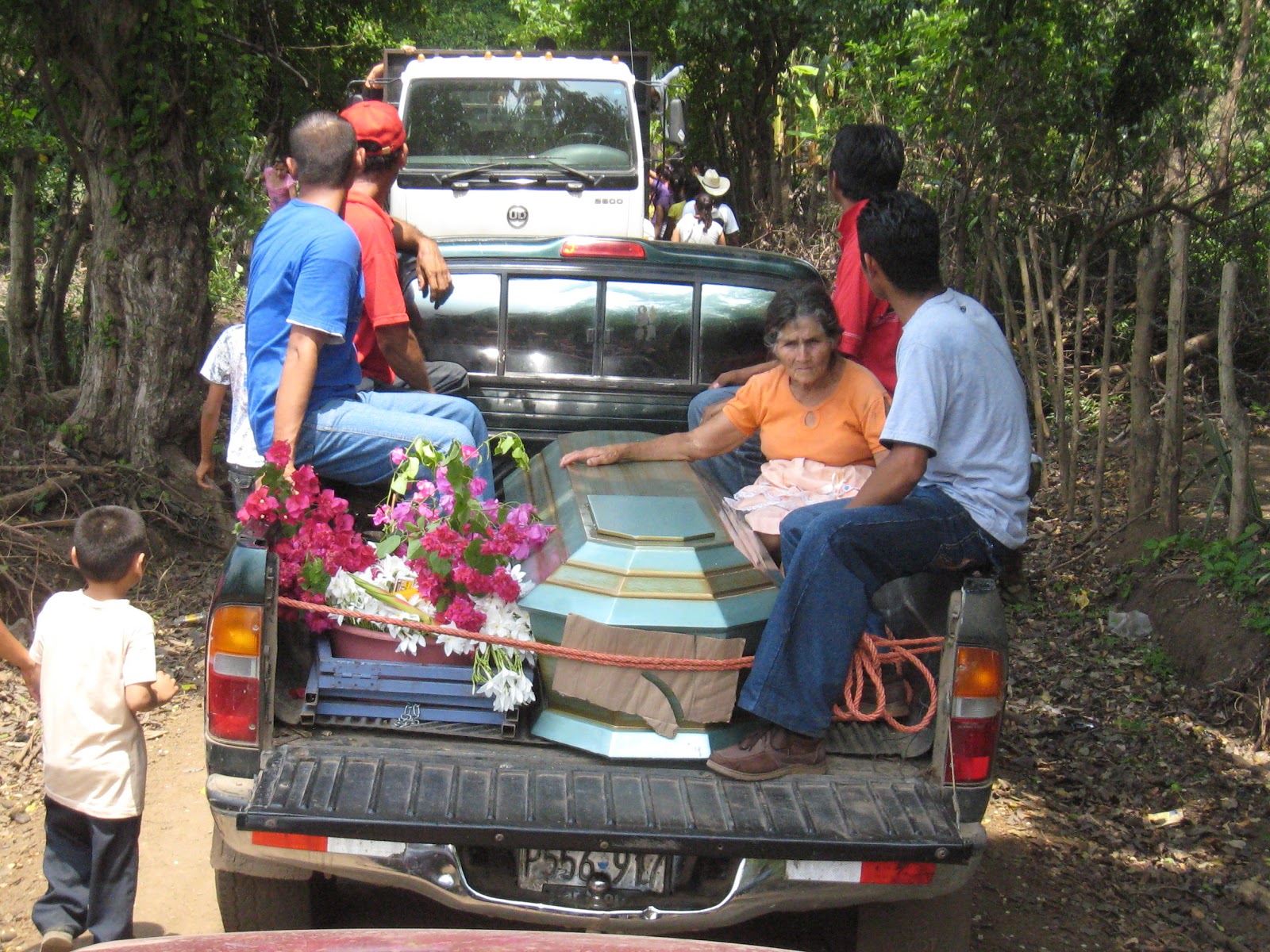
The casket being carried in a pickup

A giant truckload of people going to the cemetery

Another truckload

Driving slowly in a procession
Burial
I have never been so happy to see a cemetery and I remember thinking that was a bit peculiar. We drove up to the entrance and Kathy dropped us all off. Everyone started to pile out of the trucks and make their way over to the casket. It was placed under a concrete shelter that had a platform in the middle especially for caskets. Family was around the casket greeting friends and family. The window to the casket was open so people could take one last look at Jesús if they wanted. By the time everyone had arrived there were more than 250 people at the cemetery. I noticed that there were people walking around selling ice cream and plantains chips. Kathy said that was typical of funerals and burials here.
Soon the casket was carried down a steep hill to the gravesite below. The Pastoral Team ladies were asked to sing following the casket and during the burial. It was a surprise, but sure enough, someone had a music book and the ladies found some songs to sing. We all followed at the casket down the hill to where Jesús was to be buried. We weren’t really close to the casket and I took the opportunity to ask some questions about burial.
I’m not sure about city burial, but when the cemeteries are in the cantons the burial itself is much different than in the US. The family picks the spot where they want their loved one to be buried. There aren’t any restrictions about where the person can and can’t be buried. Sometime before the burial family and friends go to the cemetery to dig the hole using shovels they brought from home. There isn’t necessarily a caretaker like in the States who helps out and regulates burials.
Once the casket has arrived the family and friends use rope they’ve brought along with them and put it around the casket to lower into the hole. There’s no vault that the casket goes into before it’s lowered down. When the casket is lowered the rope is pulled out and they begin shoveling dirt back into the hole. Everyone else is usually present throughout the process of the burial. The grave is marked, usually with a temporary marker, until the family can return with a proper headstone, cross, or other permanent marker.
As I was asking questions some men started to put rope around Jesús’ casket and lower it into the hole. There was just one problem: the casket didn’t fit. I was surprised but everyone else seemed to take it in stride. They got out the shovels and widened the hole. The ladies kept singing and everyone else stayed put. Finally, the casket was able to be completely lowered into the hole.
After this people started praying. We wondered if they were going to do the whole rosary but they didn’t. As they were praying the men filled up the hole. You could hear the sound of the dirt hitting the casket. That’s not something you usually hear at a funeral because many people in the States don’t stay while the grave is being filled. Another sound being made during all this was the horns that the guys selling ice cream were carrying. Now, I understand this is a different culture but honking a horn while someone’s grave is being filled seems extremely rude and inappropriate to me. I wanted to snatch the guy’s horn away but managed to refrain myself.
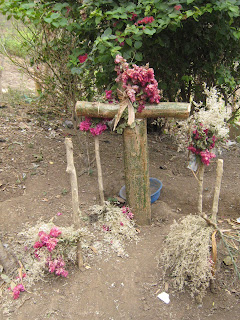
When the grave was filled it was marked with a wooden cross. The family will return when they buy a formal headstone. We stayed around a little while longer and then headed back up the hill to the truck. There wasn’t any formal service at the gravesite other than the praying and singing. Cecilia told me that when someone dies here who is Catholic there’s always a mass. It’s usually before the burial. The mass for Jesús was held this morning but we weren’t able to make it. When someone dies who is Evangelical, there is also a service of some kind.

We've reached the cemetery

The place where the coffin is kept for a short while

Selling food at the funeral

Walking down to her gravesite

It was a steep hill

Making our way there

Gathered around the gravesite

We watched as they lowered the casket down with ropes

Leaving the cemetery
Following the burial, for the next 9 days, the family and friends get together to remember their loved one if the family is Catholic. If the family is from the country (the cantons) then a rosary is said in someone’s house. Usually it’s in the family’s house of the person who died. If the family is from the city and has money, then a mass is held each day during the 9 days. At the end of the 9 days, regardless of where the family is from, they serve tamales and coffee for everyone. That is the tradition here in El Salvador.
Blanca told me that if someone is killed in the street or somewhere other than the home then the family often goes there to pray, sing, and remember the deceased. If the family is Catholic, then they will return to this place for the next 9 days to do the rosary. Also, like with traffic accidents in the US, there are often crosses alongside the road where people have been killed.
Another Catholic tradition here is to celebrate the 30th day after death. Sometimes there’s a special mass held. They also celebrate the anniversary of the death every year for nine years. Right now, Blanca’s family is celebrating the anniversary of her aunt’s death. People also go to the cemetery on Mother’s Day and Father’s Day to put flowers on their parents or grandparents graves. The Day of the Dead, called Día de los Muertos or Día de los Difuntos, is held on November 2nd here in El Salvador and is another way of remembering those who have died. I admit that one reason I really wanted to be here in November was to see the Day of the Dead celebration.
My Thoughts
When I first arrived here I told Kathy that I hoped no one died, but if they did I wanted to go to the funeral. I find different rituals and customs surrounding death very interesting. I took several death and dying classes in college and focused on gerontology and end-of-life care in graduate school where I got my Masters of Social Work. While in grad I wrote a long research paper about “What Happens to Bodies After Death.” If you have a burning interest about this topic I’d love to chat. Thus, I appreciate being able to have a better understanding of death in El Salvador and am thankful for those people who took the time to explain things to me. Not only was this experience interesting, it might even help me professionally someday.
Note: The information about death, embalming, processions, burial, and funerals in El Salvador I learned from Blanca, Cecilia, Kathy, and personal observations. I also asked the Pastoral Team and Kathy when it was okay to take photos as I did not want to be disrespectful.
Tuesday, May 10, 2011
This is what poverty looks like
Monday, 5-9-11
What a long day it has been. Today we traveled to the caserío of La Llanes which is a part of the canton of San Felipe. There are about 20 families that live there and they are all related. There is one woman in the community, Augustina, who is related to everyone. She is the matriarch, the mother, grandmother, and great-mother. She lives in the community with five of her children, her grandchildren, and her great-grandchildren.
The community does not have an official Directiva (community board recognized by the government) nor do they have a partnership with a church in the States. And they receive basically no help from other institutions in El Salvador. They do have a leadership committee and some of those members came to the house today. The Pastoral Team decided to provide their community with fertilizer for the upcoming crops and the committee had arranged for transportation for fertilizer to be delivered to their community.
We left the house at 9:00am to get the fertilizer and a few other things, and by 9:30am we were on our way to La Llanes. It is about a 45 minute drive there through San Francisco and San Felipe. Some parts of the road are a bit narrow but we made it by just fine. We didn’t rent the really big truck that we’ve used for other communities because there aren’t that many families there and the big truck probably couldn’t handle the narrowness of the road.
Much of the community was waiting for us when we arrived. We said hello and greeted people as we made our way to the house that would be our “home base” for the day. We chatted for a short while with the woman whose house we were in. Then the leader of the community board, Ismael, led us to see a far away house in the community. It wasn’t too bad of a walk but it was quite a ways away. Along the way we ate mangos that were given to us by the community. They were the yellowish ones; the kind where you bite off the skin and suck on the pulp inside. They were absolutely delicious! The pulp gets caught in your teeth but the taste is worth it.




When we returned to town more people were there and it was time to begin giving away the fertilizer. This is always a happy part of visiting the communities and a time to see everyone together. Cecilia and Blanca sat down with a list of the heads of the households in La Llanes. One by one people were called to sign for their fertilizer. Then someone would come to get the fertilizer. Two men would hoist it onto another guy’s back and he’d carry it a little ways toward the person’s house.
Then a woman came over to the fertilizer bags. Now, neither Kathy nor I have ever seen a woman carry a bag of fertilizer. But sure enough, two guys hoisted up a 220 pound bag of fertilizer onto her back and she carried it away. I was surprised and extremely proud of her. I was proud to be a female. Now that’s my kind of woman!
As the rest of the fertilizer was being passed out I walked around to chat with the kids and take their pictures. Once kids understand the concept of the camera and what it does they love having their picture taken. I loved seeing them smile when I showed them their pictures, but I couldn’t help but notice those who were barefoot and dirty. One boy had a bloated belly, probably as a result of parasites in the water. Another little girl was bathing, using the water collected in a few small barrels that the whole community uses as a water source during the rainy season.
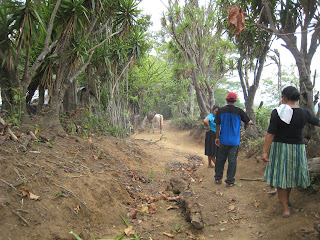
Once the fertilizer had been distributed Kathy and I walked over to see a horse. He looked relatively healthy considering the circumstances of his owner. His owner, a 78-year old man named Hipólito, came over to talk to us about his horse. We learned that his horse’s name is Tito. Then he asked if we wanted to ride it. I decided that sounded like a good idea. So I hopped up on the horse to go for a quick walk. I’ve always wanted to ride a horse in El Salvador and I was happy that the opportunity presented itself. When I finished Kathy decided to go for a ride as well. I think the community had as much fun watching the gringos ride the horse as we did actually riding the horse.
After the horse ride we walked to see where the mother/grandmother/great-grandmother of everyone lived. Augustina was nearby inside her house grinding corn. She’s in her 80s but there’s still work to be done around the house and grinding corn is no easy task. I’ve done it before and it is a difficult, tedious process that produces only small amounts of masa (dough) at a time. Blanca took over grinding corn for her while. We are fortunate enough to have someone who owns a corn grinder here in Berlín so the corn doesn’t have to be ground by hand.




Prayer for the Children
What a long day it has been. Today we traveled to the caserío of La Llanes which is a part of the canton of San Felipe. There are about 20 families that live there and they are all related. There is one woman in the community, Augustina, who is related to everyone. She is the matriarch, the mother, grandmother, and great-mother. She lives in the community with five of her children, her grandchildren, and her great-grandchildren.
The community does not have an official Directiva (community board recognized by the government) nor do they have a partnership with a church in the States. And they receive basically no help from other institutions in El Salvador. They do have a leadership committee and some of those members came to the house today. The Pastoral Team decided to provide their community with fertilizer for the upcoming crops and the committee had arranged for transportation for fertilizer to be delivered to their community.
We left the house at 9:00am to get the fertilizer and a few other things, and by 9:30am we were on our way to La Llanes. It is about a 45 minute drive there through San Francisco and San Felipe. Some parts of the road are a bit narrow but we made it by just fine. We didn’t rent the really big truck that we’ve used for other communities because there aren’t that many families there and the big truck probably couldn’t handle the narrowness of the road.
Much of the community was waiting for us when we arrived. We said hello and greeted people as we made our way to the house that would be our “home base” for the day. We chatted for a short while with the woman whose house we were in. Then the leader of the community board, Ismael, led us to see a far away house in the community. It wasn’t too bad of a walk but it was quite a ways away. Along the way we ate mangos that were given to us by the community. They were the yellowish ones; the kind where you bite off the skin and suck on the pulp inside. They were absolutely delicious! The pulp gets caught in your teeth but the taste is worth it.

On the road to La Llanes

Scenic view from above

Kind of a road

Hibiscus tree

Bamboo

Eating a mango
When we arrived at the house we learned that the woman who lived there was 46 years old and had 14 children; none of them were twins. She would have had 16 children but two died. She was “accompanied” (which is like being married) and age 12 and probably started having kids shortly after that. I could see right away that the family, like the rest of the community, was very, very poor. Several children came running out of the house to greet us. They were covered in dirt and mud. Two of the little boys were pantless. My heart broke when I looked into their little faces.
You see, the children are dirty not because the children were being bad or the parents are irresponsible, but because obtaining water in this community is extremely challenging. They literally walk for miles over rocky terrain in the scorching heat to obtain water. I could tell that some of the kids probably hadn’t bathed in quite some time. Their clothes probably haven’t been washed for a while either because the families here also lack money for clothing for their children. When you have to choose between drinking water for survival and water to wash your clothes, survival is going to win.
One of the little girls had a small guacal (plastic container) of water which she was using to clean her little brother. Unfortunately, it only seemed to be getting him dirtier, with the dirt on his face quickly turning to mud. The kids were eating some kind of fruit from a pod which I recognized as pepeto. The mother quickly offered us handfuls of pepeto pods to eat. Not wanting to take away the little food the family had we graciously accepted a few pods but did not take them all.
I took some pictures of the kids and then showed them the pictures of themselves. They smiled at the pictures. I always added something like, “Que guapo” (How handsome) or “Muy bonita” (very pretty) when showing them their pictures because the children were indeed beautiful. I could see the generosity and kindness in their faces. The kids in this community also don’t seem to be afraid of gringos and warmed up to us quickly, which is unusual for children who haven’t met many white people before. When it was time to leave I shook the kids’ hands and smiled at them. It was hard to say goodbye. I hope we have a chance to visit them again sometime. I am glad we took the time to walk to their house.
On the way back to town I thought about water. Can you imagine barely having enough water to survive? I’ve seen this kind of poverty and I still cannot conceive of the idea. Forget about basic hygiene like brushing your teeth, bathing, and washing clothes; not having enough water to drink or cook with is something I can’t even fathom. Not only that, but is the closest water source is quite a ways away, and even during the rainy season when water is more accessible they have nothing to use to store water.

Walking to the far away house

Greeted by half-nude, dirty children

One of the girls

This is what poverty looks like

The family's cross used for Dia de la Cruz

Carrying around pepetos

She offered me one

Washing off her brother

A very sad sight

Offering me some of his food

Four of the fourteen children and two parents who live here

A cross and new passion fruit plant

Walking back to town
When we returned to town more people were there and it was time to begin giving away the fertilizer. This is always a happy part of visiting the communities and a time to see everyone together. Cecilia and Blanca sat down with a list of the heads of the households in La Llanes. One by one people were called to sign for their fertilizer. Then someone would come to get the fertilizer. Two men would hoist it onto another guy’s back and he’d carry it a little ways toward the person’s house.
Then a woman came over to the fertilizer bags. Now, neither Kathy nor I have ever seen a woman carry a bag of fertilizer. But sure enough, two guys hoisted up a 220 pound bag of fertilizer onto her back and she carried it away. I was surprised and extremely proud of her. I was proud to be a female. Now that’s my kind of woman!
As the rest of the fertilizer was being passed out I walked around to chat with the kids and take their pictures. Once kids understand the concept of the camera and what it does they love having their picture taken. I loved seeing them smile when I showed them their pictures, but I couldn’t help but notice those who were barefoot and dirty. One boy had a bloated belly, probably as a result of parasites in the water. Another little girl was bathing, using the water collected in a few small barrels that the whole community uses as a water source during the rainy season.
Once the fertilizer had been distributed Kathy and I walked over to see a horse. He looked relatively healthy considering the circumstances of his owner. His owner, a 78-year old man named Hipólito, came over to talk to us about his horse. We learned that his horse’s name is Tito. Then he asked if we wanted to ride it. I decided that sounded like a good idea. So I hopped up on the horse to go for a quick walk. I’ve always wanted to ride a horse in El Salvador and I was happy that the opportunity presented itself. When I finished Kathy decided to go for a ride as well. I think the community had as much fun watching the gringos ride the horse as we did actually riding the horse.
After the horse ride we walked to see where the mother/grandmother/great-grandmother of everyone lived. Augustina was nearby inside her house grinding corn. She’s in her 80s but there’s still work to be done around the house and grinding corn is no easy task. I’ve done it before and it is a difficult, tedious process that produces only small amounts of masa (dough) at a time. Blanca took over grinding corn for her while. We are fortunate enough to have someone who owns a corn grinder here in Berlín so the corn doesn’t have to be ground by hand.

Signing for fertilizer
Those who can't sign use a thumb print

Carrying away the 220 pound bags

The leader of the group helping out

This guy's shoes were falling apart

She's all woman and she is STRONG

Watching the community

Staying close to family at first

Lounging on the fertilizer

The four families who don't own land got food packets

Bloated belly = Parasites

Blanca talking to the group

This guy was funny

A beautiful young lady

Not sure why she had the newspaper
Could be for the bathroom

One of many innocent faces

She warmed up to me

Soon I was getting group photos

Her clothes have seen better days
I hope she will see better days in the future

She liked talking to Cecilia

Talking to the kids about the horse

He offered to let me ride the horse

There I go

I'm sure everyone got a kick out of this

Kathy's turn

Fun for the gringos and the Salvadorans

The mother of the community, Augustina

Grinding corn

The cross at her house

Bathing in middle of town
Then we went to see more houses in the community. Several of us piled into the pickup including the leader of the community board and his two little girls. We drove a long ways down the road. Well, it seemed like a long ways because the road was rough but it was probably only 1 kilometer. When we couldn’t go any further with the truck we parked and hopped out. I was glad that I’d put on sunscreen because it was hot outside and I could feel the heat scorching my skin.
It was a long ways to the very last house on the trail. Probably only a kilometer away but over uneven ground and in the heat it seemed a lot further. Along the way the leader of the group who was carrying fertilizer for one of the families dropped it off at their house. We also saw the house of the man who owns the horse. When we finally reached the end of the trail we came upon a small house that was home to 11 people. We talked to the family for a while about what their lives are like.
Outside was a small pila made of wood. This is where the family washes all of it’s dishes and clothes. In order to get water they either have to walk several kilometers uphill to the town and then further along road to San Felipe. Then they’ll need to walk back to the house with cántaros (plastic jugs) on their heads. Or they can walk down to a nearby river. The problem with that is the route to get there. Apparently the trail is extremely steep and incredibly strenuous. Plus the water is filthy, filled with bacteria and animal waste. So there is no good option for this family.
We took a photo of the family and started back up the hill to see other families. At one of the houses lives a granddaughter of Augustina with her husband and her husband’s mother. Her mother-in-law is old, frail, and sick. She had a bandage wrapped around her dirty, bony feet. I can’t imagine that she’d be able to leave the house often. There is also a sick child at the house who needs medication for convulsions. It costs about $20 a month, $20 that the family doesn’t have. But somehow they manage to scrape together enough money. I wonder what they must give up so that the child can have her much needed medication. Food? Clothes? Metal for the roof?
After saying goodbye to the last house we continued walking the rest of the way up the hill. It was a hard walk up and my legs were burning. My skin was burning from the heat of the sun and I wished I’d remembered to bring my water with me. I was exhausted and thought about the cool, dump shower I would take when we got home. Then I mentally slapped myself in the face. “You selfish, greedy person!! How can you even think about yourself at a time like this?! Here are people with barely enough water to survive and all you’re thinking about the clean, easy access water back at home. Suck it up and keep moving!”
We eventually made it back up to the truck. We said hello to two more families whose homes were nearby. At one of the homes was a tiny baby. He was crying and crying. I could see beads of sweat all over his head. I thought about the heat radiating all around us and how uncomfortable he must have been. It’s hard to know what to think in situations like this. Why this child? Why must children suffer in this world? How can I make a difference? As we walked back to the truck I pondered these questions. I have yet to come up with any satisfying answers.

Pickup rides are fun

Watching us pull up

Playing on the truck

Heading down the hill

He was carrying fertilizer behind us

The house where the man with the horse lives

Walking down the path

11 people live inside this house

The wooden basin where clothes and food are washed

Another house in the community

Time to head back up the hill

It was a long walk

The mother-in-law of one
of Augustina's granddaughters

Talking to us about life in La Llanes

Another precious child

Cross at their home

Feet bandaged with old clothe

He was crying and I could see the
sweat dripping of his little head

The family

Standing by their home made of mud and wood
When we reached our home base in the community we went inside and sat down. They had made us lunch and we were all hungry. We eagerly ate the soup and tortillas they had provided for us. The Pastoral Team had brought food to the community for lunch so they didn’t have to use the little food they had. As we were eating we noticed a large guacal (plastic tub) sitting on the floor. Inside was a pillow and blanket. This was the playpen/crib used for the baby. An empty pop bottle with beans inside served as a rattle.
At 2:00pm we said goodbye to the people of La Llanes. Even though I’d just met them it was hard to say goodbye. My experience in this community will always stay with me. I’m thankful that I had the chance to meet them and learn about their lives. I hope to see them all again soon.

Making us tortillas for lunch

A plastic tub used as a cradle/playpen for the baby.
In the playpen is an old soda bottle with
beans inside that serves as a rattle

Holding onto the chicken given to the
Pastoral House by the community

Saying goodbye to the little boy.
He gave me several big hugs

Adios amiga!

The main road

Standing outside her house as we drove past

Up on a hill

Looking out over the valley

Driving home from Los Llanes
We pray for the children
who sneak popsicles before supper,
who erase holes in math workbooks,
who can never find their shoes.
And we pray for those
who stare at photographers from behind barbed wire,
who can't bound down the street in a new pair of sneakers,
who never "counted potatoes,"
who are born in places where we wouldn't be caught dead,
who never go to the circus,
who live in an X-rated world.
We pray for the children
who bring us sticky kisses and fistfuls of dandelions,
who hug us in a hurry and forget their lunch money.
And we pray for those
who never get dessert,
who have no safe blanket to drag behind them,
who watch their parents watch them die,
who can't find bread to steal,
who don't have rooms to clean up,
whose pictures aren't on anybody's dresser,
whose monsters are real.
We pray for the children
who spend their allowance before Tuesday,
who throw tantrums in the grocery store and pick at their food,
who like ghost stories,
who shove dirty clothes under the bed,
who never rinse out the tub,
who get visits from the tooth fairy,
who don't like to be kissed in front of the carpool,
who squirm in church and scream in the phone,
whose tears we sometimes laugh at and
whose smiles can make us cry.
And we pray for those
whose nightmares come in the daytime,
who will eat anything,
who have never seen dentist,
who aren't spoiled by anybody,
who go to bed hungry and cry themselves to sleep,
who live and move, but have no being
We pray for the children
who want to be carried and for those who must,
who we never give up on and for those who don't get a second chance.
We pray for those we smother and for those who will grab the hand of
anybody kind enough to offer it.
This prayer was written by Ina Hughes, a newspaper reporter for the Knoxville News. The prayer reached a worldwide audience when it was read aloud during UNICEF's World Summit For Children.
Subscribe to:
Posts (Atom)