Sunday, 9-18-11
Something beautiful happened at church tonight. We went to the 5:30pm mass like we normally do on Sundays and sat in our usual spot. Shortly after we arrived one of my third grade students showed up and sat in the pew in front of us. He comes alone, and when he sees me at school he always asks if I’ll be at the 5:30pm mass on Sunday. I respond that I’ll be there and he tells me he’ll be there as well. It’s good to see him at the mass. I like to think that I can be a good role model for my students outside of the classroom.
Another person who always comes to the 5:30pm mass is an older gentleman. He normally arrives late, sometimes more than halfway through the mass. He walks slowly and with a walking stick that looks like it used to be a broom handle. He carries the same bag made out of an old feed sack, and he’s often wearing the same clothes which are dirty and stained. Then he sits several rows ahead of us. And even though he appears very frail he always gets on his knees to kneel on the wooden kneelers when the time comes during the mass. I’m not sure where he lives or how far he walks to get to mass, but I can he’s a person with great faith.
This evening he sat in the row in front of my student, two rows in front of us. When it came time to shake hands and give peace to the people around you I decided that I wanted to shake the old man’s hand. I shook the hands of the people around me and then looked at him. I hesitated. I’m not sure why. I guess I was feeling shy, the way some people do when they want to do something but then something else holds them back.
It was nearing the end of the short time we have to greet each other with peace. I started to think that maybe I wasn’t going to shake his hand. Just then, my student turned around and looked at me for an instant, smiling. Then he tapped the old man on the shoulder. When the old man turned around my student shook his hand. Immediately, my eyes welled up with tears. I felt so proud of my student. I got up and went to shake the old man’s hand as well. As I sat down I wiped away a couple tears from my eyes. It was a beautiful moment for me, watching my student do something that I wanted to do but was hesitant about.
Tonight, my student was a good role model for me.
Showing posts with label Best blogs. Show all posts
Showing posts with label Best blogs. Show all posts
Sunday, September 18, 2011

Sunday, July 24, 2011
Death in La Llanes
Thursday, 7-21-11
When I left the house this morning for school Ismael and Walter were here from La Llanes. I wasn’t sure why they’d come but it looked serious. When I got home from school Kathy told me that someone from La Llanes had died last night. It was Benigno, the man who lives in the house with his wife and 14 children. Ismael and Walter had come to the house to let the Pastoral Team know what was going on. The Team offered to help with some of the expenses such as pan dulce and corn for the tortillas, coffee, sugar, plates, and cups. These are all things used as the family stays with their loved one until the funeral.
We drove to the community this afternoon around 1:30pm to see the family. All 86 of the people in the community are related either through blood or marriage. So the death of Benigno impacted everyone in the community. The road to the community is not easy to traverse. It’s the normal, bumpy canton road for a while but at the turnoff for the community it becomes very narrow and close to the edge of the mountain, which can make it dangerous during the rainy season.
As we drove along Kathy and I talked about the work of the Pastoral Team and how it related to our visit today to La Llanes. While monetary help and the development of projects in the communities here is very important, the work of the team is much more than that. It’s about solidarity and accompaniment of the people they serve. They feel that they are called to be servants in the Kingdom of God. That means when someone in a community dies, they do their best to not only provide financial assistance but to provide spiritual and emotional support as well.
There wasn’t the usual jubilant atmosphere when we arrived in La Llanes. A sadness seemed to hang over the community. We were immediately greeted by Reina, one of Benigno’s nieces, who had been crying. She embraced everyone and then led us away from the truck. I thought we might be walking to Benigno’s house but his body had been carried to the center of town to a house that is also used as a church for special services. Only 6 days previous we had been inside the same small building joyously celebrating their patron saint festival.
When we walked inside we were immediately hit by a wave of heat. I remembered how hot the room was during the mass for the celebration. The casket was in the middle of the room centered on some metal stands and surrounded by candles and flowers. A couple benches and chairs had been set up around the casket. The casket itself was small, as are most caskets purchased by people who live in the cantons, and had a small window where Benigno’s head was so people could look in to say goodbye. Ismael later told us that the casket cost $275, which is a significant amount of money when most of the people in the community are farmers who survive on what their crops produce.
Aside from the extreme heat and humidity there were other things that you wouldn’t typically associate with a visitation if you’d been in the US. Swarms of mosquitoes were buzzing around our legs and within a few minutes I already had several bites. The occasional chicken would wander into the house pecking around for bugs. Pigeons were rustling around inside some sort of box that was sitting in the corner. Every once and while one would fly out the open window and then swoop back inside.
Several family members were inside the house sitting down and talking to one another. We stayed and talked with the family for a while. They told us that Benigno had been sick for a while but it was only recently that his pain got really bad. He was at the patron saint festival last weekend as well as working on his farm. Then he got very sick on Wednesday and died that night. He probably had cancer but since people in the cantons can’t afford to go to the doctor for most aches and pains it was never diagnosed.
After a while we went outside to sit. When we were outside I decided to ask about Benigno’s physical appearance. I noticed when I’d looked into the casket that there was something white inside his mouth and nose. Cecilia told us it was white cloth used to keep an odor from escaping from his body. The odor, she told us, were the fumes from a poison used to dry the fluids in his body. I’m guessing the poison she was talking about is formaldehyde or a formaldehyde-based solution which they buy at the pharmacy and inject into the deceased.
Someone brought over coffee and pan dulce for everyone. We ate and talked to Ismael for a while. The Team said they’d make arrangements with Raul, whose family owns a big truck, to take people home tomorrow after the funeral in Berlín. In the morning several people would be accompanying the casket to Berlín at 7am and others would gradually make their way to town. We chatted a little longer but needed to leave at 4:30pm to get back to the house for a meeting. We said goodbye and told people we’d see them tomorrow.
Friday, 7-22-11
The funeral mass and burial for Benigno was held today in Berlín. We heard the church bells slowly ringing at 2:00pm which signaled that the mass was about to start. The bells ring much slower when there is a funeral so everyone in town knows when a funeral mass is ready to begin. We arrived at church and found there were lots of people already there. We sat in our usual spot for the mass, which followed the same format as a regular mass. At one point the small choir began to sing the song “Entre tus manos” (In your hands) which is often sung at funerals. The song always makes me a little weepy. I’ve posted the lyrics to the song before but I find them so moving that I want to repost them here:
Entre tus manos está mi vida Señor,
Entre tus manos pongo mi existir,
Hay que morir para vivir.
Entre tus manos pongo yo mi ser.
Si el grano de trigo no muere,
si no muere, solo quedará,
pero si muere en abundancia dará
un fruto eterno que no morirá.
__
In your hands is my life Lord,
In your hands I put my existence,
We must die to live.
In your hands I put my being.
If the grain of wheat does not die,
if it does not die, it remains,
But if it does die, in abundance it will give
an eternal fruit that will not die
When the mass ended the family started carrying the casket down the aisle. As the casket came down the aisle I noticed that it looked different. I asked Kathy why Benigno had a different casket she told me that it was someone else’s casket; the mass was for Benigno as well as someone else. The casket for the other person was obviously more expensive. It looked more like a casket that you’d see in the States.
I’m not sure why, but seeing the other casket followed by Benigno’s casket made me really sad. The other person’s casket was grand, large, and white. I could tell the family of the person who died had money. Benigno’s casket was small, wooden, and fashioned like the caskets they used to make in the shape of a person instead of rectangular. I don’t know how his family managed to scrape enough money together to buy the casket for him. I tried to remember that even though we all lead very different lives and may leave this world in different ways we ultimately end up in the same place. And I don’t think it matters to God what kind of casket we have when we leave.
The caskets were carried outside and both put into different pickup trucks for the procession to the cemetery. Benigno’s casket was put into an ordinary pickup. The family had some flowers that they placed on and around the casket. The other casket was put into a pickup that had been specially designed to carry caskets. There were lots of flowers and music coming from the truck. The casket sat up on a platform above the bed of the pickup in a glass box similar to the way the casket of Jesus sits during the Good Friday procession. Seeing the differences again made me sad. I put on my sunglasses so no one could see me crying.
It took about 30 minutes to walk to the cemetery. When we arrived we had to wait outside for a while so the other person’s family could have a brief service right inside the walls of the cemetery as is custom here. Cecilia and Kathy were sitting on the sidewalk comforting Carmen, one of Benigno’s sisters, who had completely broken down into tears. Suddenly a crowd surrounded one of the girls in the family who’d passed out. Then one of Benigno’s nephews passed out right next to us.
I guess they were prepared for this because someone quickly went to both people to attend to them. The woman had what appeared to be a bottle of tequila in her hands. I later found out it was something called siete espíritus (seven spirits) which is a kind of alcohol they sell in pharmacies to help revive people who’ve fainted. The woman put some of the liquid on her hands and put it under peoples’ noses to help them regain consciousness. When she came around to the man next to us she put some of it on his face as well.
Slowly the man began to come around. Ismael was sitting next to him and supporting him in case he passed out again. The girl who fainted didn’t seem to wake up. Thankfully, we saw a police truck passing by and stopped them. There’s no hospital in town so they were going to take her to the clinic. Another family member got into the truck with her and the police and sped away. During this time Kathy and Cecilia were still with Carmen while I tried to keep an eye on two little girls. The other family had carried their casket away and Benigno’s casket was set up on metal stands so people could say goodbye one last time
Soon it was time to proceed to the gravesite to bury him. We slowly made our way there. What happened in the next 20 minutes seemed like pure chaos. Several other people fainted as Benigno’s body was being lowered into the ground by family members. The woman with the siete espíritus went around to each person to try to revive them. Two different men had to be restrained because they were angry and tried to run toward the casket. I think they were upset because they didn’t want him to be buried. It took six men to hold down one of the guys who was yelling and sobbing at the same time.
María, Benigno’s wife, had also passed out cold. Several women carried her to a tomb and laid her down on it. They tried fanning her and putting the spirits under her nose to revive her but to no avail. It was all a bit surprising and a lot to take in. I’ve never seen so many people so grief stricken at a funeral. It’s hard to see people in that much pain. It’s hard to know what to do in situations like that. I don’t think there’s much you can do other than be there, physically, emotionally, and spiritually, with the people who are suffering.
The family eventually finished filling in the hole and we made our way back to the front of the cemetery. The people who’d passed out were taken to the clinic here in Berlín in mototaxis with other family members. We stayed for a little longer to be with the remaining family and make sure the truck arrived to take them home to La Llanes. Before leaving we made sure people had the phone number of the Pastoral House and told them to call if they needed anything. We said goodbye and began the walk home. I’ll end my blog with something that I found and read at my grandfather’s funeral:
Death is just another step along life’s changing way,
No more than just a gateway to a new and better day,
And parting from our loved ones is much easier to bear
When we know that they are waiting for us to join them “There”-
For it is on the Wings of Death that the living soul takes flight
Into the “Promised Land Of God” where there shall be “No Night”-
So death is just a natural thing, like the closing of a door,
As we start upon a journey to a new and distant shore-
And none need make the journey undirected or alone,
For God promised us safe passage to the vast and great unknown-
So let your grief be softened and yield not to despair,
You have only placed your loved one in the loving Father’s care.
“Be not afraid, only believe”. Mark 5:36
When I left the house this morning for school Ismael and Walter were here from La Llanes. I wasn’t sure why they’d come but it looked serious. When I got home from school Kathy told me that someone from La Llanes had died last night. It was Benigno, the man who lives in the house with his wife and 14 children. Ismael and Walter had come to the house to let the Pastoral Team know what was going on. The Team offered to help with some of the expenses such as pan dulce and corn for the tortillas, coffee, sugar, plates, and cups. These are all things used as the family stays with their loved one until the funeral.
We drove to the community this afternoon around 1:30pm to see the family. All 86 of the people in the community are related either through blood or marriage. So the death of Benigno impacted everyone in the community. The road to the community is not easy to traverse. It’s the normal, bumpy canton road for a while but at the turnoff for the community it becomes very narrow and close to the edge of the mountain, which can make it dangerous during the rainy season.
As we drove along Kathy and I talked about the work of the Pastoral Team and how it related to our visit today to La Llanes. While monetary help and the development of projects in the communities here is very important, the work of the team is much more than that. It’s about solidarity and accompaniment of the people they serve. They feel that they are called to be servants in the Kingdom of God. That means when someone in a community dies, they do their best to not only provide financial assistance but to provide spiritual and emotional support as well.
There wasn’t the usual jubilant atmosphere when we arrived in La Llanes. A sadness seemed to hang over the community. We were immediately greeted by Reina, one of Benigno’s nieces, who had been crying. She embraced everyone and then led us away from the truck. I thought we might be walking to Benigno’s house but his body had been carried to the center of town to a house that is also used as a church for special services. Only 6 days previous we had been inside the same small building joyously celebrating their patron saint festival.
When we walked inside we were immediately hit by a wave of heat. I remembered how hot the room was during the mass for the celebration. The casket was in the middle of the room centered on some metal stands and surrounded by candles and flowers. A couple benches and chairs had been set up around the casket. The casket itself was small, as are most caskets purchased by people who live in the cantons, and had a small window where Benigno’s head was so people could look in to say goodbye. Ismael later told us that the casket cost $275, which is a significant amount of money when most of the people in the community are farmers who survive on what their crops produce.
Aside from the extreme heat and humidity there were other things that you wouldn’t typically associate with a visitation if you’d been in the US. Swarms of mosquitoes were buzzing around our legs and within a few minutes I already had several bites. The occasional chicken would wander into the house pecking around for bugs. Pigeons were rustling around inside some sort of box that was sitting in the corner. Every once and while one would fly out the open window and then swoop back inside.
Several family members were inside the house sitting down and talking to one another. We stayed and talked with the family for a while. They told us that Benigno had been sick for a while but it was only recently that his pain got really bad. He was at the patron saint festival last weekend as well as working on his farm. Then he got very sick on Wednesday and died that night. He probably had cancer but since people in the cantons can’t afford to go to the doctor for most aches and pains it was never diagnosed.
After a while we went outside to sit. When we were outside I decided to ask about Benigno’s physical appearance. I noticed when I’d looked into the casket that there was something white inside his mouth and nose. Cecilia told us it was white cloth used to keep an odor from escaping from his body. The odor, she told us, were the fumes from a poison used to dry the fluids in his body. I’m guessing the poison she was talking about is formaldehyde or a formaldehyde-based solution which they buy at the pharmacy and inject into the deceased.
Someone brought over coffee and pan dulce for everyone. We ate and talked to Ismael for a while. The Team said they’d make arrangements with Raul, whose family owns a big truck, to take people home tomorrow after the funeral in Berlín. In the morning several people would be accompanying the casket to Berlín at 7am and others would gradually make their way to town. We chatted a little longer but needed to leave at 4:30pm to get back to the house for a meeting. We said goodbye and told people we’d see them tomorrow.
Friday, 7-22-11
The funeral mass and burial for Benigno was held today in Berlín. We heard the church bells slowly ringing at 2:00pm which signaled that the mass was about to start. The bells ring much slower when there is a funeral so everyone in town knows when a funeral mass is ready to begin. We arrived at church and found there were lots of people already there. We sat in our usual spot for the mass, which followed the same format as a regular mass. At one point the small choir began to sing the song “Entre tus manos” (In your hands) which is often sung at funerals. The song always makes me a little weepy. I’ve posted the lyrics to the song before but I find them so moving that I want to repost them here:
Entre tus manos está mi vida Señor,
Entre tus manos pongo mi existir,
Hay que morir para vivir.
Entre tus manos pongo yo mi ser.
Si el grano de trigo no muere,
si no muere, solo quedará,
pero si muere en abundancia dará
un fruto eterno que no morirá.
__
In your hands is my life Lord,
In your hands I put my existence,
We must die to live.
In your hands I put my being.
If the grain of wheat does not die,
if it does not die, it remains,
But if it does die, in abundance it will give
an eternal fruit that will not die
When the mass ended the family started carrying the casket down the aisle. As the casket came down the aisle I noticed that it looked different. I asked Kathy why Benigno had a different casket she told me that it was someone else’s casket; the mass was for Benigno as well as someone else. The casket for the other person was obviously more expensive. It looked more like a casket that you’d see in the States.
I’m not sure why, but seeing the other casket followed by Benigno’s casket made me really sad. The other person’s casket was grand, large, and white. I could tell the family of the person who died had money. Benigno’s casket was small, wooden, and fashioned like the caskets they used to make in the shape of a person instead of rectangular. I don’t know how his family managed to scrape enough money together to buy the casket for him. I tried to remember that even though we all lead very different lives and may leave this world in different ways we ultimately end up in the same place. And I don’t think it matters to God what kind of casket we have when we leave.
The caskets were carried outside and both put into different pickup trucks for the procession to the cemetery. Benigno’s casket was put into an ordinary pickup. The family had some flowers that they placed on and around the casket. The other casket was put into a pickup that had been specially designed to carry caskets. There were lots of flowers and music coming from the truck. The casket sat up on a platform above the bed of the pickup in a glass box similar to the way the casket of Jesus sits during the Good Friday procession. Seeing the differences again made me sad. I put on my sunglasses so no one could see me crying.
It took about 30 minutes to walk to the cemetery. When we arrived we had to wait outside for a while so the other person’s family could have a brief service right inside the walls of the cemetery as is custom here. Cecilia and Kathy were sitting on the sidewalk comforting Carmen, one of Benigno’s sisters, who had completely broken down into tears. Suddenly a crowd surrounded one of the girls in the family who’d passed out. Then one of Benigno’s nephews passed out right next to us.
I guess they were prepared for this because someone quickly went to both people to attend to them. The woman had what appeared to be a bottle of tequila in her hands. I later found out it was something called siete espíritus (seven spirits) which is a kind of alcohol they sell in pharmacies to help revive people who’ve fainted. The woman put some of the liquid on her hands and put it under peoples’ noses to help them regain consciousness. When she came around to the man next to us she put some of it on his face as well.
Slowly the man began to come around. Ismael was sitting next to him and supporting him in case he passed out again. The girl who fainted didn’t seem to wake up. Thankfully, we saw a police truck passing by and stopped them. There’s no hospital in town so they were going to take her to the clinic. Another family member got into the truck with her and the police and sped away. During this time Kathy and Cecilia were still with Carmen while I tried to keep an eye on two little girls. The other family had carried their casket away and Benigno’s casket was set up on metal stands so people could say goodbye one last time
Soon it was time to proceed to the gravesite to bury him. We slowly made our way there. What happened in the next 20 minutes seemed like pure chaos. Several other people fainted as Benigno’s body was being lowered into the ground by family members. The woman with the siete espíritus went around to each person to try to revive them. Two different men had to be restrained because they were angry and tried to run toward the casket. I think they were upset because they didn’t want him to be buried. It took six men to hold down one of the guys who was yelling and sobbing at the same time.
María, Benigno’s wife, had also passed out cold. Several women carried her to a tomb and laid her down on it. They tried fanning her and putting the spirits under her nose to revive her but to no avail. It was all a bit surprising and a lot to take in. I’ve never seen so many people so grief stricken at a funeral. It’s hard to see people in that much pain. It’s hard to know what to do in situations like that. I don’t think there’s much you can do other than be there, physically, emotionally, and spiritually, with the people who are suffering.
The family eventually finished filling in the hole and we made our way back to the front of the cemetery. The people who’d passed out were taken to the clinic here in Berlín in mototaxis with other family members. We stayed for a little longer to be with the remaining family and make sure the truck arrived to take them home to La Llanes. Before leaving we made sure people had the phone number of the Pastoral House and told them to call if they needed anything. We said goodbye and began the walk home. I’ll end my blog with something that I found and read at my grandfather’s funeral:
Death is just another step along life’s changing way,
No more than just a gateway to a new and better day,
And parting from our loved ones is much easier to bear
When we know that they are waiting for us to join them “There”-
For it is on the Wings of Death that the living soul takes flight
Into the “Promised Land Of God” where there shall be “No Night”-
So death is just a natural thing, like the closing of a door,
As we start upon a journey to a new and distant shore-
And none need make the journey undirected or alone,
For God promised us safe passage to the vast and great unknown-
So let your grief be softened and yield not to despair,
You have only placed your loved one in the loving Father’s care.
“Be not afraid, only believe”. Mark 5:36
Wednesday, June 8, 2011
For those in need
Wednesday, 6-8-11
Today we made a trip back to a community called La Llanes. Though I’ve only been there once before I was excited to be going back and couldn’t wait to see everyone again. This was the community that I visited for the first time on May 9 and wrote a blog about entitled “This is what poverty looks like.” There are 20 families in this community and they are all related through one woman named Augustina. The community does not have an official Directiva (community board recognized by the government) nor do they have a partnership with a church in the States. And they receive basically no help from other institutions in El Salvador. All of these factors contribute to making them poorer than other communities in the area.
Today was a very special visit. We were going to deliver clothing and toys to the families in La Llanes. After seeing the children dirty and wearing tattered clothes we decided that we needed to do something. One day the ladies started going through all their clothes and went through the clothes at their homes to give to the families in La Llanes. I always joke around because Cecilia’s wardrobe is bigger than Kathy and mine put together, but she was incredibly generous with what she gave away. Not only that, everyone in her family contributed something. Blanca’s entire family donated clothes as well.
Since there aren’t any small children in Cecilia’s or Blanca’s family, Kathy decided to go out and buy some children’s clothes. We went on Sunday (market day) a couple weeks ago. On market days you can find decent clothing and good prices. She was able to get lots of shorts, shirts, and shoes for the kids. We bought clothes from the people who’d set up on the street to sell. We prefer to buy from people off the street first because they don’t have permanent stores and usually need the money more than those people with stores.
Before my family came down last week someone from my church contacted me last minute about sending down some stuffed animals that had been collected by a co-worker of hers. I said yes figuring we’d use them for something. When my family brought them down to me I thought about the community of La Llanes and decided it would be a good place to take the animals. But there wasn’t enough for every child which presented a problem. Then someone from my church sent down money for me to be used at my discretion. I decided this was the perfect opportunity to use the money. Today we went to a store that sells toys to buy enough so that all 40 children in La Llanes could have a new toy. Together, the stuff animals and money donation helped to get toys to the children who only have a few.


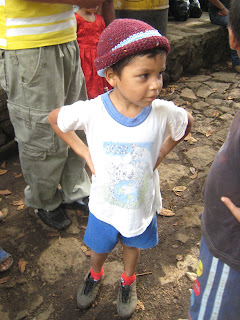


This made me feel happy and sad at the same time. Happy because they were so proud to be wearing their best clothes and looked so beautiful, but also sad because those were the only nice clothes they have and seeing us is one of the few special occasions where they will wear those clothes. I’m not sure how else to explain my feelings. But seeing the stark contrast between the clothing the children wore during our first visit and the clothing they wore this visit had an impact on me. It’s something that will stick with me for a long time.


Today we made a trip back to a community called La Llanes. Though I’ve only been there once before I was excited to be going back and couldn’t wait to see everyone again. This was the community that I visited for the first time on May 9 and wrote a blog about entitled “This is what poverty looks like.” There are 20 families in this community and they are all related through one woman named Augustina. The community does not have an official Directiva (community board recognized by the government) nor do they have a partnership with a church in the States. And they receive basically no help from other institutions in El Salvador. All of these factors contribute to making them poorer than other communities in the area.
Today was a very special visit. We were going to deliver clothing and toys to the families in La Llanes. After seeing the children dirty and wearing tattered clothes we decided that we needed to do something. One day the ladies started going through all their clothes and went through the clothes at their homes to give to the families in La Llanes. I always joke around because Cecilia’s wardrobe is bigger than Kathy and mine put together, but she was incredibly generous with what she gave away. Not only that, everyone in her family contributed something. Blanca’s entire family donated clothes as well.
Since there aren’t any small children in Cecilia’s or Blanca’s family, Kathy decided to go out and buy some children’s clothes. We went on Sunday (market day) a couple weeks ago. On market days you can find decent clothing and good prices. She was able to get lots of shorts, shirts, and shoes for the kids. We bought clothes from the people who’d set up on the street to sell. We prefer to buy from people off the street first because they don’t have permanent stores and usually need the money more than those people with stores.
Before my family came down last week someone from my church contacted me last minute about sending down some stuffed animals that had been collected by a co-worker of hers. I said yes figuring we’d use them for something. When my family brought them down to me I thought about the community of La Llanes and decided it would be a good place to take the animals. But there wasn’t enough for every child which presented a problem. Then someone from my church sent down money for me to be used at my discretion. I decided this was the perfect opportunity to use the money. Today we went to a store that sells toys to buy enough so that all 40 children in La Llanes could have a new toy. Together, the stuff animals and money donation helped to get toys to the children who only have a few.

Toys for the kids in La Llanes

Bags loaded in the truck
We left the house around 2:00pm with the back of the truck loaded with clothes and toys. It was a beautiful ride to La Llanes. Since the rainy season has started everything is much greener than it was the first time we visited. We could see people out planting and new seedlings starting to grow. When we arrived the committee of La Llanes was there to greet us as well as several small children. One of the kids was playing with a homemade capirucho made from a plastic bottle and twig. My heart broke when I realized that his family could probably not afford to buy him one. But he was happy just the same and was ready to play with us when we got there.
We greet everyone with handshakes and hugs. A few more people from the committee arrived shortly after us. They had been out in the fields spraying to protect their crops. The spray is basically weed killer designed to kill the weeds but not the crops. And with the poor harvest last year people in the cantons are depending on a good crop this year. Though I’ve been told the spray is not dangerous it didn’t smell good and I wondered if it negatively affects their health. That situation would really be a double bind: you need to the spray but it’s harmful to your health, but if you don’t use the spray your crops could die. Not an easy situation.
Once all the committee was there they started sorting through the bags to decide what things would be best for certain families. It was a fun process to watch; a cross between Christmas shopping and clothes shopping. The clothes were divided up equally between the different families. I stood back to watch, take pictures, and chat with people for a while. It was an amazing sight. This truly is a great example of the poor (Blanca and Cecilia’s families) giving to the poor. Because as Blanca frequently said, “There is always someone poorer than you.”

Beautiful view

I love the mountains

Planting time

Beans are beginning to sprout

Looking out at the view

At the gate of the community

Holding his homemade capirucho

Augustina had butterfly land on her hand

Back from spraying

Looking at the clothes

That's not for you, Kathy!

Several hats
While the committee finished sorting through the clothes we were invited next door for some coffee and pan dulce. We went inside the modest home built from mud bricks and wood. The woman inside was making fresh coffee, probably roasted and ground at home. Though I am not at all a coffee drinker I really wanted to drink coffee and have pan dulce with everyone else. I asked for a little bit of coffee and got some pan dulce as well. The pan dulce was delicious, and the coffee tasted liked coffee so I didn’t like it. I had a really hard time getting through that last sip. As Kathy said, “It was chunky,” which I imagine is great for people who really like strong coffee.
Soon the rest of the community had arrived and it was time to begin giving away the clothing and toys. The committee had put all the clothing into bags for each family. The president of the committee called each family forward to receive their bag. When they did Kathy and I looked at the complete census of the community to see how many children were in each family as well as their gender and age. We gave out badminton racquets, dolls, plastic tea sets, plastic kitchen sets, jump ropes, and toy trucks, cars, and motorcycles. It was a lot fun watching people get their clothes and watching the kids get their toys. There is great joy in being able to help others.

Sleeping in the hammock

Fresh coffee brewing

Holding up the baby

Inside the home used for a church

What the inside and outside of the walls look like

Oved used for baking bread

So ugly it's almost cute

He likes his hat

The president of the committee, Ismael

Receiving their gifts

I told him the car was not just for him

Cute baby girl

Another cutie

Inspecting their toys

Squeak toys for the baby

He likes his truck

Sleeping

The trucks were a big hit

She got little badminton racquets

This is the family with 14 kids

Calling off names

Holding her new teddy bear

Playing with a stuffed zebra
I noticed that a couple of people were wearing nice clothes, especially the children. Several of the little girls were dressed up in fancy dresses and overall the children also looked a lot cleaner than our previous visit. There are probably a few reasons for this. One is that the rainy season has started so people have access to the rain water. They don’t have much to store the water but at least now they don’t have to walk miles and miles to get the water (provided that it rains frequently).
The second reason they were dressed up and clean (I confirmed this with Cecilia) was because they knew we were coming this time. Cecilia said that the people in the cantons who don’t have a lot of money may only have one nice outfit. When people come to visit they put on their best clothing. She said that at Christmastime the fathers will buy one nice dress for his daughters. When visitors come the girls will often wear that special dress. But normally, she said, the way we saw people dressed on our first visit is how they usually dress.
This made me feel happy and sad at the same time. Happy because they were so proud to be wearing their best clothes and looked so beautiful, but also sad because those were the only nice clothes they have and seeing us is one of the few special occasions where they will wear those clothes. I’m not sure how else to explain my feelings. But seeing the stark contrast between the clothing the children wore during our first visit and the clothing they wore this visit had an impact on me. It’s something that will stick with me for a long time.
Contrast Photos - First & Second Visit

First visit to a house with 14 children

Seeing her broke my heart

During our visit today she
had on a beautiful red dress
***

During our first visit

A beautiful little face

She was crying at first but was
happy when she got her toy today
***

The president of the committee's
daughter on our first visit

She quickly warmed up to us

Today she wore clean clothes
without any tears in them
We finished handing out the clothes and toys and by then it was time to leave. The community invited us back in July for their Patron Saint Festival for the Virgin of Carmen. I hope we’re able to make it! We hugged people and waved goodbye to everyone. It was a good day.
“Some people come into our lives and quickly go. Some people move our souls to dance. They awaken us to the new understanding with the passing whisper of their wisdom. Some people make the sky more beautiful to gaze upon. They stay in our lives for a while, leave footprints on our hearts, and we are never ever the same.” Flavia Weedn

The rain moving in as we drive home
Sunday, May 15, 2011
Death in the cantons
Saturday, 5-14-11
Sickness & Death
Two weeks ago I went to the community of Río de los Bueyes for their annual Celebration of the Martyrs where Balmore was going to do a Celebration of the Word. Before the celebration started we went to see an older woman, named Jesús, and her family that live not far from where the celebration was being held. I’d never met her before but the Pastoral Team and Kathy know her well.
She was very sick when we went to see her; almost all skin and bones. Since she wasn’t eating much she had a nutrient supplement hanging up in what appeared to be an IV bag. It was a strange sight for the cantons. I asked Kathy about it and she said that a health promoter might be the one who helps out and administers the IV. We stayed a short while talking to her family. Jesús only stayed to talk for 20 minutes before she tired and went to her room to lay down.
Yesterday the Pastoral House got a call that Jesús was asking for the Pastoral Team. So Blanca, Cecilia, and Kathy drove to Río de los Bueyes to see her. They only stayed 30 minutes because Jesús was weary and very sick. Kathy said she wasn’t eating or drinking and she was coughing up blood. Her stomach was bloated. We all knew she was close to death.
Last night they got a call that Jesús had died. The burial was to be tomorrow. Normally the Pastoral Team goes to someone’s house right after there has been a death to provide moral support, but because it was late and a storm was coming they decided to wait until tomorrow. Sometime around 11:00pm the family stopped by to pick up some money from the Pastoral House. The Pastoral Team often helps families with funeral expenses.
At this point let me explain a little bit about what happens to a body after death here in El Salvador. When someone dies here in the cantons the body usually remains at the house. They are not taken to the morgue or a funeral home. There isn’t embalming done the way it’s done in the US. In the US you usually have embalming chemicals for the blood vessels and the body cavity itself. Hypodermic and surface embalming can be done if needed. The ideas behind embalming in the US are sanitation, presentation, and preservation.
Here in El Salvador in the cantons if the family has enough money they can pay a health promoter or someone else to come and give an injection of formaldehyde into the body in order to preserve the body. The chemicals for an injection can be bought at a pharmacy. This is done usually for preservation of the body. Even though people here are typically buried soon after death it is a hot country and the body is normally kept in the home until burial. However, many people in the cantons cannot afford this injection so there is no preservation done.
Someone from the family goes to purchase the casket for their loved one. Like in the US, there are special stores, called funererias, where you can purchase caskets. The casket can be delivered to the home or the family can take it there themselves. These places serve people at all hours. I asked Cecilia about it and she told me that if it’s the middle of the night (like with Jesús) you basically knock on the door and then go in to purchase the casket.
Unlike in the US, the families in the cantons are the ones that typically prepare the body for burial. Some families have more resources than others but most of the time not much is done to the body. The family will dress the person and sometimes wash the body beforehand. A towel may be tied around the face to help keep the mouth closed. Other than that not much else is done to the body, especially if the family is from the cantons and doesn’t have a lot of money.
One thing is for sure: the body isn’t as “pretty” after death as it is in the US. In the US, several different things are often done to the body. Moisturizing cream can be added to the skin and lips so they don’t dry out. Makeup is often added to the person. A heavy makeup is used to cover bruises, cuts, or other things. Makeup is also used to make the person still look as if blood is flowing through their veins. A person’s hair may be styled, fingernails painted, or their face shaved. They are usually dressed in business attire such as a coat and tie or suit for men and a dress or pantsuit for women.
Procession
Today was to be the burial (entierro) of Jesús. We piled into the pickup and headed down to Río de los Bueyes. It’s about a 55 minute drive there and you can feel it getting hotter as you drive down the mountain. We were a little late but no one had left the house yet because they were all waiting for a big truck to carry people to the cemetery. We stood around for a while at the house and talked to a few people. When the truck to haul the people still had not arrived 15 minutes later they decided to start the procession.
Family members helped lift the casket into the back of a pickup truck. Five people got into the back with the casket while Jesús’ daughter and a grandchild got into the cab. There was no tailgate so a rope was tied in its place to prevent the casket from sliding out during the drive. A piece of cardboard was stuck between the casket and the rope to ensure the casket wouldn’t be scratched. Then the truck started driving away at a slow pace.
I was in the back of the Pastoral Team’s truck along with 21 other people. I didn’t know we could fit that many people in the back of the truck. There were also 4 people in the cab of the truck for a total of 26 people. As we slowly drove to the cemetery more people joined the procession. There were at least 4 more pickup trucks carrying people as well as 2 giant trucks full of people. As we drove along more people were waiting by the side of the road to be picked up to go to the cemetery.
It was a long procession that lasted over an hour, and it was a very hot, dusty ride. Not a long distance, but we moved slowly. It must have been in the mid-90s down in the valley and that coupled with 21 other people in the hot sun makes for a long ride. I was drenched in sweat and not terribly comfortable. I had no idea where the cemetery was or how far away it was but I didn’t want to ask for fear of sounding rude and impatient. I later learned that Kathy was very tired and was trying not to nod off at the wheel. It’s not exactly cool inside the truck either.
This is how people get to the cemetery in El Salvador, even when the person has money. There’s either a long procession by car with some people crowded into a pickup truck or other large truck or the casket is carried in a pickup while people walk behind it to the cemetery. Many times the people who are walking behind the truck with the casket sing songs along the way. I’ve seen many processions but had never been a part of one.


Remembering the Deceased
Sickness & Death
Two weeks ago I went to the community of Río de los Bueyes for their annual Celebration of the Martyrs where Balmore was going to do a Celebration of the Word. Before the celebration started we went to see an older woman, named Jesús, and her family that live not far from where the celebration was being held. I’d never met her before but the Pastoral Team and Kathy know her well.
She was very sick when we went to see her; almost all skin and bones. Since she wasn’t eating much she had a nutrient supplement hanging up in what appeared to be an IV bag. It was a strange sight for the cantons. I asked Kathy about it and she said that a health promoter might be the one who helps out and administers the IV. We stayed a short while talking to her family. Jesús only stayed to talk for 20 minutes before she tired and went to her room to lay down.
Yesterday the Pastoral House got a call that Jesús was asking for the Pastoral Team. So Blanca, Cecilia, and Kathy drove to Río de los Bueyes to see her. They only stayed 30 minutes because Jesús was weary and very sick. Kathy said she wasn’t eating or drinking and she was coughing up blood. Her stomach was bloated. We all knew she was close to death.
Last night they got a call that Jesús had died. The burial was to be tomorrow. Normally the Pastoral Team goes to someone’s house right after there has been a death to provide moral support, but because it was late and a storm was coming they decided to wait until tomorrow. Sometime around 11:00pm the family stopped by to pick up some money from the Pastoral House. The Pastoral Team often helps families with funeral expenses.
At this point let me explain a little bit about what happens to a body after death here in El Salvador. When someone dies here in the cantons the body usually remains at the house. They are not taken to the morgue or a funeral home. There isn’t embalming done the way it’s done in the US. In the US you usually have embalming chemicals for the blood vessels and the body cavity itself. Hypodermic and surface embalming can be done if needed. The ideas behind embalming in the US are sanitation, presentation, and preservation.
Here in El Salvador in the cantons if the family has enough money they can pay a health promoter or someone else to come and give an injection of formaldehyde into the body in order to preserve the body. The chemicals for an injection can be bought at a pharmacy. This is done usually for preservation of the body. Even though people here are typically buried soon after death it is a hot country and the body is normally kept in the home until burial. However, many people in the cantons cannot afford this injection so there is no preservation done.
Someone from the family goes to purchase the casket for their loved one. Like in the US, there are special stores, called funererias, where you can purchase caskets. The casket can be delivered to the home or the family can take it there themselves. These places serve people at all hours. I asked Cecilia about it and she told me that if it’s the middle of the night (like with Jesús) you basically knock on the door and then go in to purchase the casket.
Unlike in the US, the families in the cantons are the ones that typically prepare the body for burial. Some families have more resources than others but most of the time not much is done to the body. The family will dress the person and sometimes wash the body beforehand. A towel may be tied around the face to help keep the mouth closed. Other than that not much else is done to the body, especially if the family is from the cantons and doesn’t have a lot of money.
One thing is for sure: the body isn’t as “pretty” after death as it is in the US. In the US, several different things are often done to the body. Moisturizing cream can be added to the skin and lips so they don’t dry out. Makeup is often added to the person. A heavy makeup is used to cover bruises, cuts, or other things. Makeup is also used to make the person still look as if blood is flowing through their veins. A person’s hair may be styled, fingernails painted, or their face shaved. They are usually dressed in business attire such as a coat and tie or suit for men and a dress or pantsuit for women.
Procession
Today was to be the burial (entierro) of Jesús. We piled into the pickup and headed down to Río de los Bueyes. It’s about a 55 minute drive there and you can feel it getting hotter as you drive down the mountain. We were a little late but no one had left the house yet because they were all waiting for a big truck to carry people to the cemetery. We stood around for a while at the house and talked to a few people. When the truck to haul the people still had not arrived 15 minutes later they decided to start the procession.
Family members helped lift the casket into the back of a pickup truck. Five people got into the back with the casket while Jesús’ daughter and a grandchild got into the cab. There was no tailgate so a rope was tied in its place to prevent the casket from sliding out during the drive. A piece of cardboard was stuck between the casket and the rope to ensure the casket wouldn’t be scratched. Then the truck started driving away at a slow pace.
I was in the back of the Pastoral Team’s truck along with 21 other people. I didn’t know we could fit that many people in the back of the truck. There were also 4 people in the cab of the truck for a total of 26 people. As we slowly drove to the cemetery more people joined the procession. There were at least 4 more pickup trucks carrying people as well as 2 giant trucks full of people. As we drove along more people were waiting by the side of the road to be picked up to go to the cemetery.
It was a long procession that lasted over an hour, and it was a very hot, dusty ride. Not a long distance, but we moved slowly. It must have been in the mid-90s down in the valley and that coupled with 21 other people in the hot sun makes for a long ride. I was drenched in sweat and not terribly comfortable. I had no idea where the cemetery was or how far away it was but I didn’t want to ask for fear of sounding rude and impatient. I later learned that Kathy was very tired and was trying not to nod off at the wheel. It’s not exactly cool inside the truck either.
This is how people get to the cemetery in El Salvador, even when the person has money. There’s either a long procession by car with some people crowded into a pickup truck or other large truck or the casket is carried in a pickup while people walk behind it to the cemetery. Many times the people who are walking behind the truck with the casket sing songs along the way. I’ve seen many processions but had never been a part of one.

Driving through Casa de Zinc
en route to Rio de los Bueyes

Looking back at the mountains
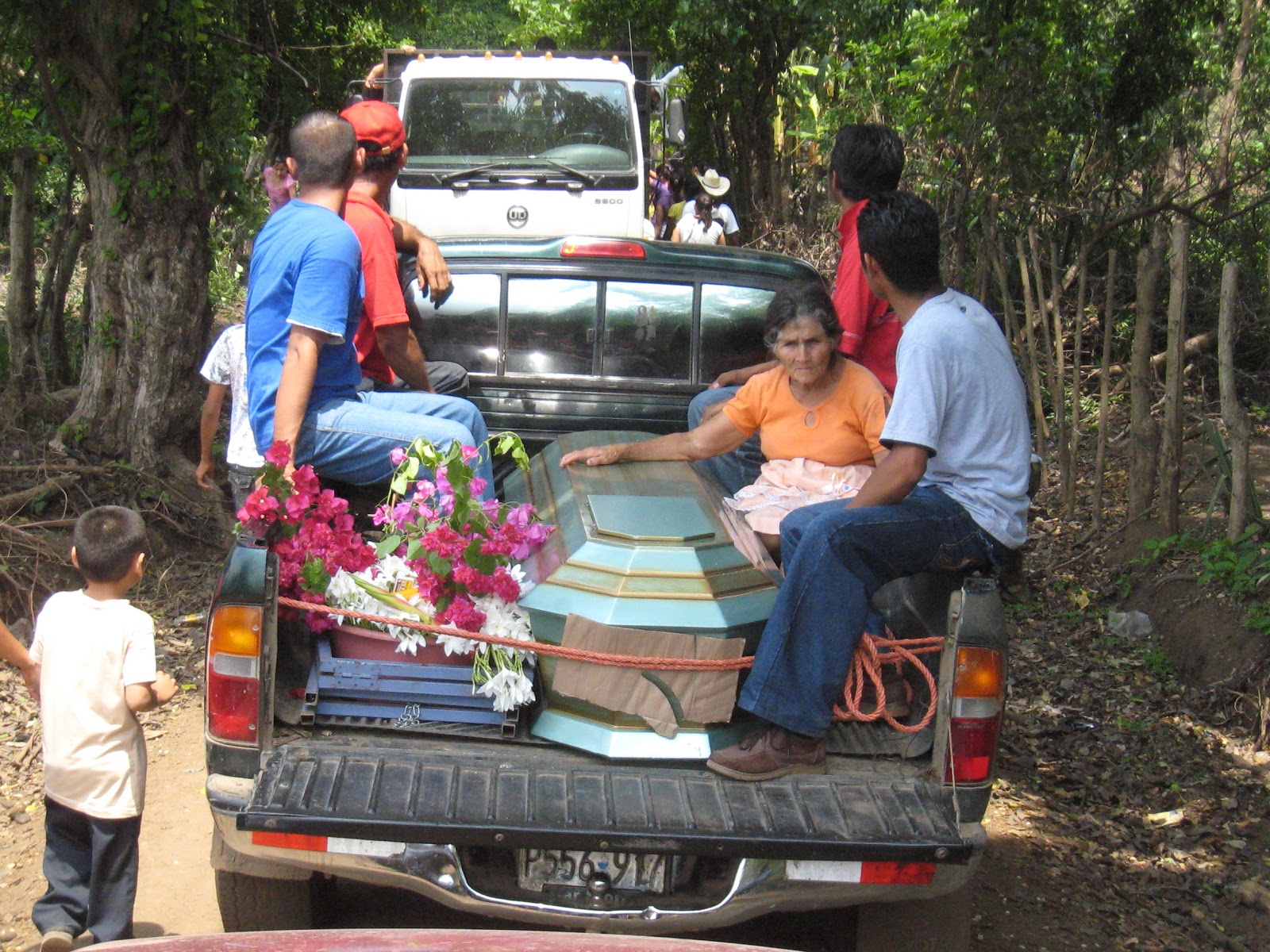
The casket being carried in a pickup

A giant truckload of people going to the cemetery

Another truckload

Driving slowly in a procession
Burial
I have never been so happy to see a cemetery and I remember thinking that was a bit peculiar. We drove up to the entrance and Kathy dropped us all off. Everyone started to pile out of the trucks and make their way over to the casket. It was placed under a concrete shelter that had a platform in the middle especially for caskets. Family was around the casket greeting friends and family. The window to the casket was open so people could take one last look at Jesús if they wanted. By the time everyone had arrived there were more than 250 people at the cemetery. I noticed that there were people walking around selling ice cream and plantains chips. Kathy said that was typical of funerals and burials here.
Soon the casket was carried down a steep hill to the gravesite below. The Pastoral Team ladies were asked to sing following the casket and during the burial. It was a surprise, but sure enough, someone had a music book and the ladies found some songs to sing. We all followed at the casket down the hill to where Jesús was to be buried. We weren’t really close to the casket and I took the opportunity to ask some questions about burial.
I’m not sure about city burial, but when the cemeteries are in the cantons the burial itself is much different than in the US. The family picks the spot where they want their loved one to be buried. There aren’t any restrictions about where the person can and can’t be buried. Sometime before the burial family and friends go to the cemetery to dig the hole using shovels they brought from home. There isn’t necessarily a caretaker like in the States who helps out and regulates burials.
Once the casket has arrived the family and friends use rope they’ve brought along with them and put it around the casket to lower into the hole. There’s no vault that the casket goes into before it’s lowered down. When the casket is lowered the rope is pulled out and they begin shoveling dirt back into the hole. Everyone else is usually present throughout the process of the burial. The grave is marked, usually with a temporary marker, until the family can return with a proper headstone, cross, or other permanent marker.
As I was asking questions some men started to put rope around Jesús’ casket and lower it into the hole. There was just one problem: the casket didn’t fit. I was surprised but everyone else seemed to take it in stride. They got out the shovels and widened the hole. The ladies kept singing and everyone else stayed put. Finally, the casket was able to be completely lowered into the hole.
After this people started praying. We wondered if they were going to do the whole rosary but they didn’t. As they were praying the men filled up the hole. You could hear the sound of the dirt hitting the casket. That’s not something you usually hear at a funeral because many people in the States don’t stay while the grave is being filled. Another sound being made during all this was the horns that the guys selling ice cream were carrying. Now, I understand this is a different culture but honking a horn while someone’s grave is being filled seems extremely rude and inappropriate to me. I wanted to snatch the guy’s horn away but managed to refrain myself.
When the grave was filled it was marked with a wooden cross. The family will return when they buy a formal headstone. We stayed around a little while longer and then headed back up the hill to the truck. There wasn’t any formal service at the gravesite other than the praying and singing. Cecilia told me that when someone dies here who is Catholic there’s always a mass. It’s usually before the burial. The mass for Jesús was held this morning but we weren’t able to make it. When someone dies who is Evangelical, there is also a service of some kind.

We've reached the cemetery

The place where the coffin is kept for a short while

Selling food at the funeral

Walking down to her gravesite

It was a steep hill

Making our way there

Gathered around the gravesite

We watched as they lowered the casket down with ropes

Leaving the cemetery
Following the burial, for the next 9 days, the family and friends get together to remember their loved one if the family is Catholic. If the family is from the country (the cantons) then a rosary is said in someone’s house. Usually it’s in the family’s house of the person who died. If the family is from the city and has money, then a mass is held each day during the 9 days. At the end of the 9 days, regardless of where the family is from, they serve tamales and coffee for everyone. That is the tradition here in El Salvador.
Blanca told me that if someone is killed in the street or somewhere other than the home then the family often goes there to pray, sing, and remember the deceased. If the family is Catholic, then they will return to this place for the next 9 days to do the rosary. Also, like with traffic accidents in the US, there are often crosses alongside the road where people have been killed.
Another Catholic tradition here is to celebrate the 30th day after death. Sometimes there’s a special mass held. They also celebrate the anniversary of the death every year for nine years. Right now, Blanca’s family is celebrating the anniversary of her aunt’s death. People also go to the cemetery on Mother’s Day and Father’s Day to put flowers on their parents or grandparents graves. The Day of the Dead, called Día de los Muertos or Día de los Difuntos, is held on November 2nd here in El Salvador and is another way of remembering those who have died. I admit that one reason I really wanted to be here in November was to see the Day of the Dead celebration.
My Thoughts
When I first arrived here I told Kathy that I hoped no one died, but if they did I wanted to go to the funeral. I find different rituals and customs surrounding death very interesting. I took several death and dying classes in college and focused on gerontology and end-of-life care in graduate school where I got my Masters of Social Work. While in grad I wrote a long research paper about “What Happens to Bodies After Death.” If you have a burning interest about this topic I’d love to chat. Thus, I appreciate being able to have a better understanding of death in El Salvador and am thankful for those people who took the time to explain things to me. Not only was this experience interesting, it might even help me professionally someday.
Note: The information about death, embalming, processions, burial, and funerals in El Salvador I learned from Blanca, Cecilia, Kathy, and personal observations. I also asked the Pastoral Team and Kathy when it was okay to take photos as I did not want to be disrespectful.
Subscribe to:
Posts (Atom)